



Get started learning to build your own electronics by following our FREE online courses below!
Learn More »
Categories
- animatronics (12)
- apple (11)
- arduino (179)
- art (41)
- articles (121)
- artificial intelligence (11)
- automation (421)
- avr (205)
- bitcoin (3)
- breadboard (9)
- cameras (57)
- cars (26)
- cell phones (28)
- clothing mods (21)
- console mods (26)
- dangerous (94)
- desktop mods (24)
- embedded (5)
- flying things (54)
- fpga (22)
- gaming creations (108)
- interface (225)
- internet (17)
- laptop mods (6)
- lasers (22)
- linux (7)
- magnetic (3)
- medical (12)
- microcontrollers (51)
- misc projects (152)
- msp (12)
- music (124)
- pic (90)
- projects (23)
- pyroedu (76)
- raspberry pi (26)
- robots (312)
- security (36)
- sensors (307)
- software (200)
- solar (19)
- stamp (9)
- tools (149)
- tutorials (98)
- Uncategorized (45)
- usb (44)
- wireless (256)
Sponsors
Build Like A Pyro!
Find many of the parts used on this site at our favorite online electronics shop


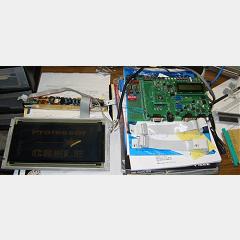
A Flat Panel Display Controller
Posted November 15, 2011 by Chris
“Raster-scan displays, like a TV, require a number of synchronization signals to operate. The display is addressed as multiple, consecutive, horizontal lines, which scan from left to right, displaying a large number of pixels on the line as it advances. At the end of a line, the display begins to scan the next line from left to right until the entire frame (consisting of many lines) is displayed.”

HD44780-based LCDs with AVR’s
Posted November 5, 2011 by Chris
“On this page I will describe how to communicate with HD44780-based LCDs (Liquid Crystal Displays) using an Atmel AVR microcontroller. The page is mainly meant as a place for me to keep information on the pinouts of the display modules I have used, and to gather info about these displays, for me and others to use.”

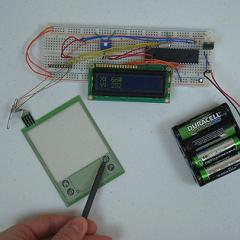
Simple Touch Screen Interface
Posted October 27, 2011 by Chris
Touch screens seem to be the must-have innovation of the decade as they’re seen in almost every new gadget and gizmo that comes out. But how exactly do they work and how can we use them? This PyroElectro article explains how a standard 4-wire resistive touch screen works and how to get the X/Y coordinates of a touched point using a PIC 18F452 microcontroller.
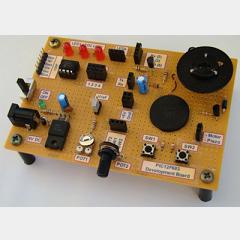
DIY PIC12F683 Development Board
Posted October 21, 2011 by Chris
“Our purpose here is to explore the potential of PIC12F683 micro for which we need a development board. The good thing is we are going to make our own board. The schematic and the actual board that I have built are shown below. I soldered all the components on a 12 x 8 cm general purpose prototyping board. ”
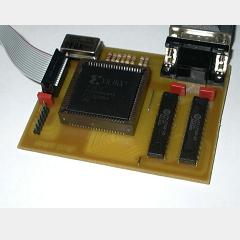
8-bit CPLD Graphics Card
Posted October 17, 2011 by Chris
This 8-bit graphics card uses a resistor DAC, CPLD and some SRAM for a frame buffer. The article gives a brief overview (in german) of what the system uses, but the devil is in the details: the source code and hardware schematic/board layout are available for download. If you’ve ever wanted to make your own low-profile video card, this design will get you started.
VGA Interface Using Only 74xx IC’s
Posted October 6, 2011 by Chris
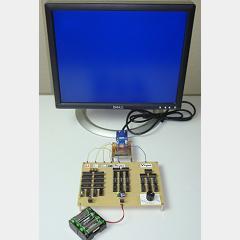
To go with my other vga oriented projects here’s a VGA interface that is built entirely with TTL discrete logic chips. I built it primarily for the 7400 contest over at dangerous prototypes, so give a comment over there if you like the design. This interface outputs the proper Hsync and Vsync signals using some 74193 counters and uses an 8-state machine to output different color signals to an LCD.
PS/2 Keyboard To 16×2 LCD
Posted September 29, 2011 by Chris
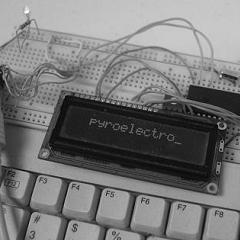
If you want to make a super simple I/O system that anyone can use, the ps/2 keyboard and a standard 16×2 LCD is all you need. This article explains how to display input from a PS/2 keyboard on a 16×2 lcd with a few example ‘commands’ like backspace and delete. PS/2 and 16×2 LCD theory is explained, the hardware schematic is included and the software available in the article.
Flash MMC to Serial Adapter
Posted September 28, 2011 by Chris
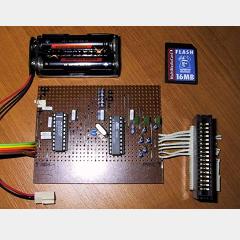
With Flash memory being everywhere these days and extremely cheap, you’d be crazy not to try and understand how to interface to at least one flash memory device. This article uses a sourceforge project to build up an MMC memory device to RS232 serial converter. Hardware schematics and software are available for download.

Build A DIY PS/2 Interface
Posted September 22, 2011 by Chris
This week’s PyroElectro article dives into the PS/2 protocol. Using a PIC microcontroller and a standard PS/2 keyboard, learn how to make your own keyboard interface that translates keypresses and outputs them to a 7 segment LED display. The article explains the theory and has all the hardware schematics and software used in the design available for download.

16 Bit FPGA Calculator
Posted September 8, 2011 by Chris
One of the primary building blocks of a processor is called the ALU (arithmetic logic unit). It allows for quick and easy arithmetic, sometimes in line with DSP. This project gives a quick introduction for how to make an ALU for a calculator using the Altera UP2 platform.
Currently Hot

Build A CPLD Dev Board
make your own cpld development board

Build A ByteBlaster
build a cable so you can program your fpga/cpld

Interfacing A PIC To LCD (16×2)
control an lcd display with a pic

Short Range Personal Radar
a complete radar system using the ir range sensor

The IR Range Sensor
learn the basics of the sharp ir range sensor
Animatronics

Recent Articles

Arduino DDS Shield
build your own arduino based analog signal generator

A Digital Multimeter In Review (Tenma 72-7735)
learn about your typical digital multimeter in review

The PIC Annoy PCB
build something to annoy your co-workers

Automate Your Life With Cron
learn how to use cron for computer automation

Web Scraping For Weather Updates
learn how to use php to scrape the web

Creating A Web Server In Linux
learn how to make a lamp web server in linux

Stepper Motor Control With A stepRocker TMCM-1110
learn how a commercial stepper motor controller works

Arduino To PIC Wireless Proximity Motor Control
control a motor with a distance sensor wirelessly

PIC to Arduino Wireless Communication via XBee
use xbee to make a pic wirelessly talk to an arduino

Motor Control via Infrared Distance Sensor
control a motor simply by waving your hand

