



Get started learning to build your own electronics by following our FREE online courses below!
Learn More »
Categories
- animatronics (12)
- apple (11)
- arduino (179)
- art (41)
- articles (121)
- artificial intelligence (11)
- automation (421)
- avr (205)
- bitcoin (3)
- breadboard (9)
- cameras (57)
- cars (26)
- cell phones (28)
- clothing mods (21)
- console mods (26)
- dangerous (94)
- desktop mods (24)
- embedded (5)
- flying things (54)
- fpga (22)
- gaming creations (108)
- interface (225)
- internet (17)
- laptop mods (6)
- lasers (22)
- linux (7)
- magnetic (3)
- medical (12)
- microcontrollers (51)
- misc projects (152)
- msp (12)
- music (124)
- pic (90)
- projects (23)
- pyroedu (76)
- raspberry pi (26)
- robots (312)
- security (36)
- sensors (307)
- software (200)
- solar (19)
- stamp (9)
- tools (149)
- tutorials (98)
- Uncategorized (45)
- usb (44)
- wireless (256)
Sponsors
Build Like A Pyro!
Find many of the parts used on this site at our favorite online electronics shop


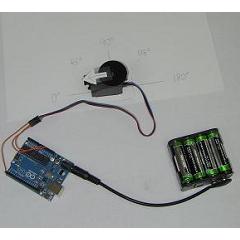
Arduino Servo Motor Controller
Posted September 13, 2012 by Chris
“We have already explored how to control a servo motor using a PIC microcontroller, but this time let’s take a look at how to control a servo motor using the Arduino platform. We’re not trying to do anything extra-ordinary in this article, just trying to make the servo motor move to the specific angle that we want it to be at and stay there.”
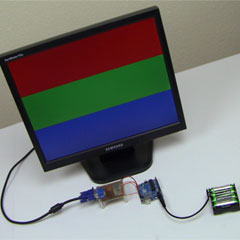
An Arduino Outputting VGA Signals
Posted September 6, 2012 by Chris
“In the past I have built many, many VGA based projects,, but never with Arduino and so, in this article, we will use the Arduino UNO platform to simulate VGA signals using straight C code. This doesn’t even come close to how video card designers do it, but it’s a fun exercise in seeing how well we understand the timing of the Arduino and AVR microcontroller as well as the VGA protocol.”

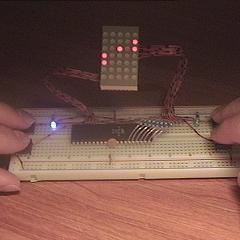
Tiny 5×7 LED DOT Matrix Pong
Posted September 4, 2012 by Chris
“The classic pong game. Two players. Press the buttons to move paddles up/down. Ball bounces back and forth. If you fail to catch it, your opponent gets one point. Score difference is showed with blue LEDs. Blue LED = lead by one point. If you then win another point, you win the game, and your player number ("1" or "2") is displayed.”
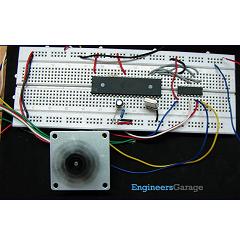
8051 Micro + ULN2003 Stepper Motor Control
Posted September 3, 2012 by Chris
“This project is an extension to two-phase Unipolar Stepper motor interfacing with AT89C51. In the previous project, transistor switches were used to interface the stepper motor with the microcontroller. Here the transistors have been replaced by using a ULN2003 IC to drive the stepper with 8051 microcontroller.”

LED Menorah Powered By AVR Tiny13
Posted September 2, 2012 by Chris
“Controlled by an AVR ATtiny13, powered by ~3v (unregulated to save on parts), one button operation and sleep mode when the menorah “burns out” after an hour or so”

On/Off Controller Using A Touch LCD with ATMega
Posted September 1, 2012 by Chris
“An on-off controller is the simplest form of a temperature control device. The output from the device is either on or off, with no middle state. This on-off controller will switch the output only when the temperature crosses the set-point. For heating control, the output is on when the temperature is below the set-point, and off above set-point.”
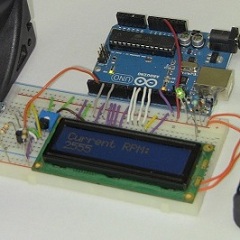
Super Simple Arduino Tachometer
Posted August 30, 2012 by Chris
“In this article we will explore how to use an IR transmitter and receiver break-beam pair similar to the PIC Tachometer project I built a few months ago, but because of popular demand, the Arduino system will be used for all the processing and break-beam interruption counting. The end result will be a 16×2 LCD displaying the RPM of some computer fans.”

Multichannel USB Analog Sensor with ATMega48
Posted August 27, 2012 by Chris
“Sometimes it’s tempting to re-invent the wheel to make a device function exactly the way you want. I am re-visiting the field of homemade electrophysiology equipment, and although I’ve already published a home made electocardiograph (ECG), I wish to revisit that project and make it much more elegant, while also planning for a pulse oximeter, an electroencephalograph (EEG), and an electrogastrogram (EGG).”
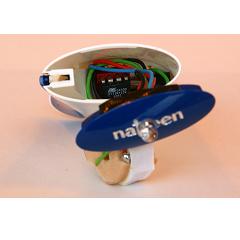
AVR Nikon Camera Remote Control
Posted July 19, 2012 by Chris
“This is an IR remote control for Nikon cameras. It is compatible with the Nikon ML-L3 remote control…The circuit is extremely simple: an ATtiny13V, button, transistor, resistor, IR diode and 3V battery. You could even omit the transistor and resistor, and connect the IR diode directly to the ATtiny13V, but that will limit the LED current and therefor the range.”

Digital Room to Room Intercom
Posted July 15, 2012 by Chris
“There are many ways to build an intercom; an example is batteries in series with 2 telephones, a key switch and an amplifier. I felt this was far too simple. I decided to build an intercom with an MCU which digitalizes a voice and then sends it serially and then regenerates the analog signal.”
Currently Hot

Programming the eBOX
create & download an os image to the eBOX-II

The Altera DE2 Board
a simple introduction for setting up the DE2 board
The eBOX-II Embedded PC
learn the in's and out's of the eBOX-II

Stepper Motor Control
control a stepper motor using an LMD18245

PIC Prototyping Basics
build your own pic prototype development board
Animatronics

Recent Articles

Arduino DDS Shield
build your own arduino based analog signal generator

A Digital Multimeter In Review (Tenma 72-7735)
learn about your typical digital multimeter in review

The PIC Annoy PCB
build something to annoy your co-workers

Automate Your Life With Cron
learn how to use cron for computer automation

Web Scraping For Weather Updates
learn how to use php to scrape the web

Creating A Web Server In Linux
learn how to make a lamp web server in linux

Stepper Motor Control With A stepRocker TMCM-1110
learn how a commercial stepper motor controller works

Arduino To PIC Wireless Proximity Motor Control
control a motor with a distance sensor wirelessly

PIC to Arduino Wireless Communication via XBee
use xbee to make a pic wirelessly talk to an arduino

Motor Control via Infrared Distance Sensor
control a motor simply by waving your hand

