



Get started learning to build your own electronics by following our FREE online courses below!
Learn More »
Categories
- animatronics (12)
- apple (11)
- arduino (179)
- art (41)
- articles (121)
- artificial intelligence (11)
- automation (421)
- avr (205)
- bitcoin (3)
- breadboard (9)
- cameras (57)
- cars (26)
- cell phones (28)
- clothing mods (21)
- console mods (26)
- dangerous (94)
- desktop mods (24)
- embedded (5)
- flying things (54)
- fpga (22)
- gaming creations (108)
- interface (225)
- internet (17)
- laptop mods (6)
- lasers (22)
- linux (7)
- magnetic (3)
- medical (12)
- microcontrollers (51)
- misc projects (152)
- msp (12)
- music (124)
- pic (90)
- projects (23)
- pyroedu (76)
- raspberry pi (26)
- robots (312)
- security (36)
- sensors (307)
- software (200)
- solar (19)
- stamp (9)
- tools (149)
- tutorials (98)
- Uncategorized (45)
- usb (44)
- wireless (256)
Sponsors
Build Like A Pyro!
Find many of the parts used on this site at our favorite online electronics shop


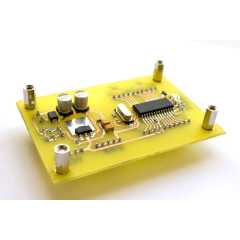
DIY PIC16F883 Development Board
Posted June 9, 2013 by Chris
“Few month ago I wanted to try to write software for Microchip PIC16F883 microcontroller and I couldn’t find simple development board for it. And so I made my own.”

Watch Controlled Robot
Posted June 8, 2013 by Chris
“The accelerometer om the watch controls the vehicle. Tilt the watch forward and the robot moves forward. Tilt the watch to the side, and the robot turns. The left top and bottom buttons control the grabber.”
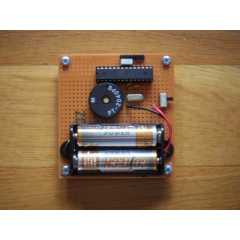
Algorithmic AVR 8-bit Workshop
Posted June 7, 2013 by Chris
“I was asked to give a workshop regarding sound art in Super Public Art School that is held at Titanik-gallery in Turku. As I have been working lately with microcontroller based sound synthesis I searched for a good topic around this area. So the idea to build pocket sized audio players came a long.”

4000 Series Logic Devices Overview
Posted June 6, 2013 by Chris
Now it’s time for our second bonus lessons on PyroEDU’s Digital Course. We’ll finish the course off by looking at 4000 Series Logic Devices. Here’s a quick intro of what this PyroEDU lesson is all about:
This bonus lesson dives into the more advanced 4000 logic IC’s available to us as designers and looks specifically at 3 interesting IC’s. The experiment for this lesson is to build a 4-bit single IC counter.

Walleye
Posted June 5, 2013 by Chris
“Walleye is an interactive light installation which engages users in temporal gestural and bodily play. It generates temporal light propagation patterns, or a large scale very low resolution pixilated image (depending on how you look at it) based on the realtime movement of visitors in the space.”

Ultrasonic + Line Sensor And Shell With SMAC 802.15.4
Posted June 4, 2013 by Chris
“With this I have an autonomous robot based on the FRDM-KL25Z board and a chassis from Pololu. It performs line following and maze solving, and can be controlled by a remote shell or controller unit (e.g. with an accelerometer).”
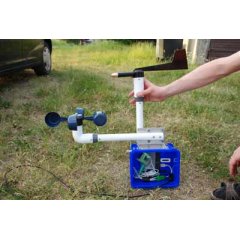
NSLU2 Wind Sensor
Posted June 3, 2013 by Chris
“The story behind this experiment was to investigate the average wind speed to motivate a future wind turbine project. A commercial logging weathers station cost much. So this is an attempt to build a good alternative cheap solution.”

An AVR Microcontroller Based Electronic Dice
Posted June 1, 2013 by Chris
“If you look at the code for our electronic dice then you will see that it is just a counter. It counts up while you press a button. Why is this a prefect dice? It’s a dice because microcontrollers do operations in ?s and humans are unable to control pushbuttons and time with the precision of ?-seconds.”
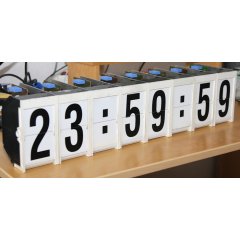
DIY Split-flap Display Driving Circuit
Posted May 31, 2013 by Chris
“A while ago I got my hands on some old split-flap displays from a train station. Yesterday I finished driver circuits for 8 of the segments. It was only just in time to also quickly implement a clock algorithm for an extraordinary clock to display the turn of the year. Don’t miss the movie at the end of this posting.”
7400 Series Logic Devices Overview
Posted May 30, 2013 by Chris
Now it’s time for our two bonus lessons on PyroEDU’s Digital Course. We’ll start by looking at 7400 Series Logic Devices. Here’s a quick intro of what this PyroEDU lesson is all about:
After you have mastered the digital fundamentals you are ready to grow and move to the more complex areas that exist. This bonus lesson dives into the more advanced 7400 logic IC’s available to us as designers and looks specifically at 3 interesting IC’s. The experiment for this lesson is to build a knight rider LED circuit.
Currently Hot

The Stunning Camera
shock your friends when they take your picture

A Simple File Server
make a file server on your pc

A Simple VHDL Counter
create a simple counter using vhdl with a cpld

An Introduction To VHDL
a small tutorial on using vhdl with a cpld

The Autonomous Drifter
autonomous drifter controlled by your laptop
Animatronics

Recent Articles

Arduino DDS Shield
build your own arduino based analog signal generator

A Digital Multimeter In Review (Tenma 72-7735)
learn about your typical digital multimeter in review

The PIC Annoy PCB
build something to annoy your co-workers

Automate Your Life With Cron
learn how to use cron for computer automation

Web Scraping For Weather Updates
learn how to use php to scrape the web

Creating A Web Server In Linux
learn how to make a lamp web server in linux

Stepper Motor Control With A stepRocker TMCM-1110
learn how a commercial stepper motor controller works

Arduino To PIC Wireless Proximity Motor Control
control a motor with a distance sensor wirelessly

PIC to Arduino Wireless Communication via XBee
use xbee to make a pic wirelessly talk to an arduino

Motor Control via Infrared Distance Sensor
control a motor simply by waving your hand

