



Get started learning to build your own electronics by following our FREE online courses below!
Learn More »
Categories
- animatronics (12)
- apple (11)
- arduino (179)
- art (41)
- articles (121)
- artificial intelligence (11)
- automation (421)
- avr (205)
- bitcoin (3)
- breadboard (9)
- cameras (57)
- cars (26)
- cell phones (28)
- clothing mods (21)
- console mods (26)
- dangerous (94)
- desktop mods (24)
- embedded (5)
- flying things (54)
- fpga (22)
- gaming creations (108)
- interface (225)
- internet (17)
- laptop mods (6)
- lasers (22)
- linux (7)
- magnetic (3)
- medical (12)
- microcontrollers (51)
- misc projects (152)
- msp (12)
- music (124)
- pic (90)
- projects (23)
- pyroedu (76)
- raspberry pi (26)
- robots (312)
- security (36)
- sensors (307)
- software (200)
- solar (19)
- stamp (9)
- tools (149)
- tutorials (98)
- Uncategorized (45)
- usb (44)
- wireless (256)
Sponsors
Build Like A Pyro!
Find many of the parts used on this site at our favorite online electronics shop


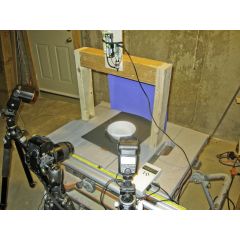
Photographing Splashing Droplets
Posted May 11, 2014 by Chris
"Up until now I’ve been using a photogate sensor and the Camera Axe to take pictures of water and milk droplets. After some research I found many – people – online were using solenoid valves to create droplets and take pictures of them. The big advantage to this method is it’s easy to collide drops which is was very difficult and random using my old method."

Trash Talk
Posted May 9, 2014 by Chris
"Trash Talk is a prototype for an inexpensive, mesh-networked, democratic public address system. Each node contains a speaker, a microphone, a radio, and an easy to use single-button interface. To send a message, simply walk up to any node, press the button, and talk."

Microcontrollers: Design A Cyclops Eye
Posted May 8, 2014 by Chris
In this week’s PyroEDU lesson in our new course: An Introduction To Microcontrollers, we will Build A Cyclops Eye using a microcontroller outputting PWM to some LEDs. Here’s an overview of the lesson:
"Another internal module in microcontrollers generates what is called a PWM output. In this lesson, we will explore using these PWM output modules to make a cyclops eye with fading LEDs."
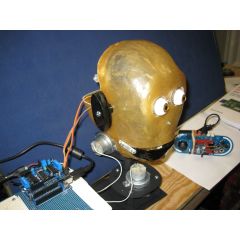
Wireless Arduino Esplora Controls Robotic Head
Posted May 7, 2014 by Chris
"The Esplora sketch was modified to poll the joystick (4 directions) and the right button cluster. When they are activated, an appropriate ASCII character is sent via serial to the XBee which sends it to the Uno which controls the head via a Motorshield."
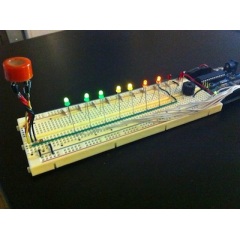
Getting Started with a Breathalyzer Sensor
Posted May 5, 2014 by Chris
"We’re exploring a whimsical project to collect breathalyzer data from various locations for use in visualizing local trends in intoxication. This weekend I completed the first step by prototyping simple hardware that reacts to various amounts of booze on the breath."

Loki Robot
Posted May 4, 2014 by Chris
"Loki builds upon the software of Seeker and Mr. Roboto, including remote control and diagnostics over WiFi, but adds more capable vision processing, speech recognition, indoor pathfinding (Using A*), basic Artificial Intelligence, and general refinement of the architecture."

Stephanie – Robot Face Prototype
Posted May 3, 2014 by Chris
"I wanted to go for a mad science robot look. I really liked pictures of robot face prototypes with electronics sort of bursting from the back. I envisioned control wires coming out from behind a mask and running all around the room to control various things, looking like hair, or veins, or roots, depending on which analogy you wish to use. The face was easy enough to procure; Hobby Lobby sells basic androgenous masks. I also wanted a few animatronic features, like a moving mouth. For this, I took a geared DC motor out of a Billy Bass singing fish."
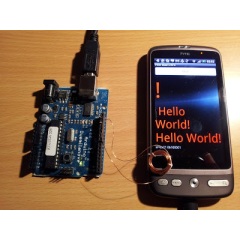
Arduino to Android IO on the cheap
Posted May 2, 2014 by Chris
"This article describes how to implement a very low bandwidth one way communication channel between an Arduino and an Android device using nothing more than about a meter of magnet wire, a resistor and diode. Links to a software sketch for the Arduino and the Android source code is included."
Microcontrollers: Build A Game
Posted May 1, 2014 by Chris
In this week’s PyroEDU lesson in our new course: An Introduction To Microcontrollers, we will Build an LED Game using a microcontroller, push button, LEDs and a trimpot. Here’s an overview of the lesson:
"At this point, we have tons of knowledge about microcontrollers, let’s take a break and do something fun: design a game! This game will be a game of skill with push buttons and LEDs."

Currently Hot

How To Build An 8x8x8 LED Cube
build an 8x8x8 led cube to mezmorize your friends

Simple RF Receiver And Transmitter @ 27 MHz
build a simple 27 mhz receiver module

Simple 27 MHz RF Transmitter
build a simple rf transmitter with very few parts

Multi Servo Control Using Arduino UNO
control many servos at once using arduino uno

Fading LED Heart Birthday Present
an led heart as a simple birthday present
Animatronics

Recent Articles

Arduino DDS Shield
build your own arduino based analog signal generator

A Digital Multimeter In Review (Tenma 72-7735)
learn about your typical digital multimeter in review

The PIC Annoy PCB
build something to annoy your co-workers

Automate Your Life With Cron
learn how to use cron for computer automation

Web Scraping For Weather Updates
learn how to use php to scrape the web

Creating A Web Server In Linux
learn how to make a lamp web server in linux

Stepper Motor Control With A stepRocker TMCM-1110
learn how a commercial stepper motor controller works

Arduino To PIC Wireless Proximity Motor Control
control a motor with a distance sensor wirelessly

PIC to Arduino Wireless Communication via XBee
use xbee to make a pic wirelessly talk to an arduino

Motor Control via Infrared Distance Sensor
control a motor simply by waving your hand

