



Get started learning to build your own electronics by following our FREE online courses below!
Learn More »
Categories
- animatronics (12)
- apple (11)
- arduino (179)
- art (41)
- articles (121)
- artificial intelligence (11)
- automation (421)
- avr (205)
- bitcoin (3)
- breadboard (9)
- cameras (57)
- cars (26)
- cell phones (28)
- clothing mods (21)
- console mods (26)
- dangerous (94)
- desktop mods (24)
- embedded (5)
- flying things (54)
- fpga (22)
- gaming creations (108)
- interface (225)
- internet (17)
- laptop mods (6)
- lasers (22)
- linux (7)
- magnetic (3)
- medical (12)
- microcontrollers (51)
- misc projects (152)
- msp (12)
- music (124)
- pic (90)
- projects (23)
- pyroedu (76)
- raspberry pi (26)
- robots (312)
- security (36)
- sensors (307)
- software (200)
- solar (19)
- stamp (9)
- tools (149)
- tutorials (98)
- Uncategorized (45)
- usb (44)
- wireless (256)
Sponsors
Build Like A Pyro!
Find many of the parts used on this site at our favorite online electronics shop


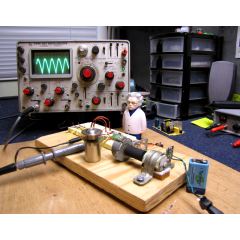
Stepper Motors As Generators
Posted August 9, 2014 by Chris
"Stepper motors are everywhere! They’re pretty easy to find in old abandoned printers. They come in a variety of configurations and number of poles but they all make great electrical generators! Any electric motor will also output a voltage when it’s freely spinning."
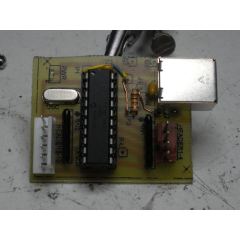
HID QuickKey USB Adapter
Posted August 8, 2014 by Chris
"The hardware is based on Microchip’s Low Pin Count USB Development Kit for the 1814K50. It is setup with 10 inputs, each with a pull-up resistor. The firmware is programmed with USB Human Interface Device Keyboard example from Microchip Solutions. It requires no drivers or special setup, it is plug and play."

Parallel Hardware – New CPLD PyroEDU Lesson!
Posted August 7, 2014 by Chris
Did you know that FPGAs and CPLDs allow you to design hardware inside of them that operate entirely in parallel? This week, we explore this topic in Lesson 7: Parallel Hardware as part of our new PyroEDU course: An Introduction to CPLD and FPGA. Here’s a short overview of the lesson:
"A powerful tool of CPLD and FPGA design is being able to create multiple modules that perform operations in parallel. Let’s explore how this is done and why it is so awesome. "
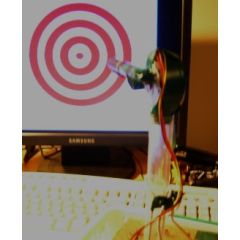
Robotic Turret With An AVR + Stepper Motor
Posted August 6, 2014 by Chris
"Essentially, I wanted to be able to control a little robotic arm / turret using a PC with a serial port. I thought this was a worthwhile project because I could later adapt it to aim a webcam, Nerf toy gun, or maybe even a felt pen so it could draw pictures."

Karl Salzmann – TT8
Posted August 5, 2014 by Chris
"From Dec. 11th to 21st, I had my first residency at STEIM. I arrived with a number of turntables and hardware equipment to go further with my idea of building an instrument consisting of 8 turntables that are controllable by one unit to use them as an instrument."

TinyPCRemote – An ATtiny85 Based Infrared PC remote control
Posted August 4, 2014 by Chris
"Here’s a cheap way to build your own fully customisable infrared PC remote control. If you already have a suitable infrared remote control going spare you can build one of these for under £4, it will allow you to use most infrared remote controls to issue keyboard commands on your PC."

NewGlove Power glove Project
Posted August 3, 2014 by Chris
"This is development board designed by me for the ATmega8 microcontroller. It is a miniature ARDUINO. You can burn your bootloader and then use with Arduino IDE or you can simply upload your hex file using DAPA programmer circuit."

DIY ATmega8 Mini Development Board
Posted August 2, 2014 by Chris
"This is development board designed by me for the ATmega8 microcontroller. It is a miniature ARDUINO. You can burn your bootloader and then use with Arduino IDE or you can simply upload your hex file using DAPA programmer circuit."
Design A Binary Timer In A CPLD – New PyroEDU Lesson!
Posted July 31, 2014 by Chris
Timing and CPLDs is such an important idea that we dedicated a whole lesson to the topic. This week, we’re moving on to: Lesson 6: Design A Binary Timer as part of our new PyroEDU course: An Introduction to CPLD and FPGA. Here’s an overview of the lesson:
"We built a binary counter using all hardware components in the Digital Course, but now let’s build a binary counter by programming it using VHDL code."
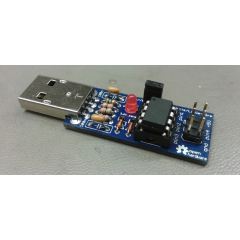
Little Wire AVR Programmer And More
Posted July 29, 2014 by Chris
"When i saw simpleavr’s implementation of usbtiny on attiny45 , i thought it would be cool if i make a kit version of this with a minimal form factor. Then i designed a PCB and sent for first prototype. Later on i thought, if i want to sell this, it would be much cooler ,and more suitable with “Open Source Hardware” concept, if i bring this project one step ahead. So i tried to fit anything extra to the device and this Little Wire project came out."
Currently Hot

How To Build An 8x8x8 LED Cube
build an 8x8x8 led cube to mezmorize your friends

Simple RF Receiver And Transmitter @ 27 MHz
build a simple 27 mhz receiver module

Simple 27 MHz RF Transmitter
build a simple rf transmitter with very few parts

Multi Servo Control Using Arduino UNO
control many servos at once using arduino uno

Fading LED Heart Birthday Present
an led heart as a simple birthday present
Animatronics

Recent Articles

Arduino DDS Shield
build your own arduino based analog signal generator

A Digital Multimeter In Review (Tenma 72-7735)
learn about your typical digital multimeter in review

The PIC Annoy PCB
build something to annoy your co-workers

Automate Your Life With Cron
learn how to use cron for computer automation

Web Scraping For Weather Updates
learn how to use php to scrape the web

Creating A Web Server In Linux
learn how to make a lamp web server in linux

Stepper Motor Control With A stepRocker TMCM-1110
learn how a commercial stepper motor controller works

Arduino To PIC Wireless Proximity Motor Control
control a motor with a distance sensor wirelessly

PIC to Arduino Wireless Communication via XBee
use xbee to make a pic wirelessly talk to an arduino

Motor Control via Infrared Distance Sensor
control a motor simply by waving your hand

