



Get started learning to build your own electronics by following our FREE online courses below!
Learn More »
Categories
- animatronics (12)
- apple (11)
- arduino (179)
- art (41)
- articles (121)
- artificial intelligence (11)
- automation (421)
- avr (205)
- bitcoin (3)
- breadboard (9)
- cameras (57)
- cars (26)
- cell phones (28)
- clothing mods (21)
- console mods (26)
- dangerous (94)
- desktop mods (24)
- embedded (5)
- flying things (54)
- fpga (22)
- gaming creations (108)
- interface (225)
- internet (17)
- laptop mods (6)
- lasers (22)
- linux (7)
- magnetic (3)
- medical (12)
- microcontrollers (51)
- misc projects (152)
- msp (12)
- music (124)
- pic (90)
- projects (23)
- pyroedu (76)
- raspberry pi (26)
- robots (312)
- security (36)
- sensors (307)
- software (200)
- solar (19)
- stamp (9)
- tools (149)
- tutorials (98)
- Uncategorized (45)
- usb (44)
- wireless (256)
Sponsors
Build Like A Pyro!
Find many of the parts used on this site at our favorite online electronics shop



DIY Segway From Scooter Parts
Posted August 25, 2013 by Chris
“The main reason that I wanted to build a DIY Segway was simply because I wanted to see if it was possible. I also liked the idea of building something that strongly interacts with humans. I will now describe how I built it.”

PiBBot – Robotic Balancer Project
Posted August 20, 2013 by Chris
“This is a very early prototype, confirming that all the hardware works and the I can get the time of the main loop down to 20ms, which was easy. This prototype also helped me get my head around the code and math needed to balance.”

Walking Aid For the Blind
Posted August 18, 2013 by Chris
“Our final product – again non-commercial – is a pair of shoes attached with ultrasonic sensors on the sensing side. The information, obtained from these sensors, is used to form a virtual map of the surroundings.”

DIY I2C Motor Controller
Posted August 12, 2013 by Chris
“The idea of building my own I2C smart DC motor controller is came to me when I was learning and playing together with my son on his LEGO MINDSTORM NXT 2.0 about a year ago. The NXT sophisticated controller also called NXT Intelligent Brick is powered by Atmel 32-bit ARM7 AT91SAM7S256 microcontroller and communicating with Atmel 8-bit AVR ATmega48 acting as a co-microcontroller using I2C protocol.”

Conversion of Cheap Optical Mouse to Robot Odometer
Posted August 11, 2013 by Chris
“For a small robot project I needed a way to measure a robot’s progress across the floor. There are various possibilities, such as: use stepper motors, add an encoder to the wheels or use the optical sensor for a mouse.”
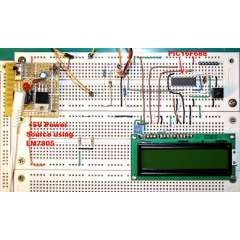
PIC-based Digital Voltmeter (DVM)
Posted August 4, 2013 by Chris
“This project will describe how to make a simple digital voltmeter (DVM) using a PIC16F688 microcontroller. The range of this DVM is 0-20V, but you can easily increase or decrease the range of input voltage as your requirements after you understand the voltage scaling method described in this project.”

Designing Lego Mindstorms NXT sensors
Posted August 2, 2013 by Chris
“I bought a Lego Mindstorms kit last month to mess with, I’ve got some ideas for robot localisation that I want to try out. Anyway, the kit comes with a sonar range finder but I wanted a little more accuracy and smaller detection area….A couple of companies sell after market sensors for the NXT, Mindsensors and HiTechnic but it’s much more fun to design and build your own.”

BrainMap With Real-Time Analysis
Posted July 28, 2013 by Chris
“We chose this project because of a combined interest in brain-computer interfaces. In an attempt to balance cost, complexity, and sensor density, we decided to implement a NIRS-inspired system. After collecting data from the array, the results were sent to a computer and displayed in a Java GUI.”
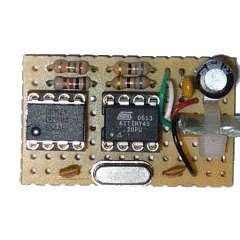
I2C Tiny USB
Posted July 24, 2013 by Chris
“The i2c-tiny-usb project is an open source/open hardware project. The goal of i2c-tiny-usb is to provide a cheap generic i2c interface to be attached to the usb. It is meant as a replacement for those simple and cheap printer port to i2c adapters. A USB solution has several advantages incl. the built-in power supply and a more future proof interface.”
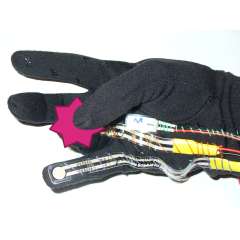
SudoGlove Hardware Controller
Posted July 20, 2013 by Chris
“The SudoGlove is a gesture controller that can be easily interfaced with hardware or software via a wireless connection. The glove implements an array of sensors plus filtering circuitry and mathematical analysis firmware to derive state values for each sensor and transmits them to an authorized receiver.”
Currently Hot

An Arduino Outputting VGA Signals
output some basic vga using an arduino uno

Super Simple Arduino Tachometer
build an arduino tachometer and measure rpms

Arduino 16×2 LCD Interface
display characters on an lcd using your arduino

DE0-Nano FPGA Tilt Sensing
use the de0-nano board to sense tilt and acceleration
DE0-Nano FPGA Breakout Board
build your own custom i/o expander breakout board
Animatronics

Recent Articles

Arduino DDS Shield
build your own arduino based analog signal generator

A Digital Multimeter In Review (Tenma 72-7735)
learn about your typical digital multimeter in review

The PIC Annoy PCB
build something to annoy your co-workers

Automate Your Life With Cron
learn how to use cron for computer automation

Web Scraping For Weather Updates
learn how to use php to scrape the web

Creating A Web Server In Linux
learn how to make a lamp web server in linux

Stepper Motor Control With A stepRocker TMCM-1110
learn how a commercial stepper motor controller works

Arduino To PIC Wireless Proximity Motor Control
control a motor with a distance sensor wirelessly

PIC to Arduino Wireless Communication via XBee
use xbee to make a pic wirelessly talk to an arduino

Motor Control via Infrared Distance Sensor
control a motor simply by waving your hand

