



Get started learning to build your own electronics by following our FREE online courses below!
Learn More »
Categories
- animatronics (12)
- apple (11)
- arduino (179)
- art (41)
- articles (121)
- artificial intelligence (11)
- automation (421)
- avr (205)
- bitcoin (3)
- breadboard (9)
- cameras (57)
- cars (26)
- cell phones (28)
- clothing mods (21)
- console mods (26)
- dangerous (94)
- desktop mods (24)
- embedded (5)
- flying things (54)
- fpga (22)
- gaming creations (108)
- interface (225)
- internet (17)
- laptop mods (6)
- lasers (22)
- linux (7)
- magnetic (3)
- medical (12)
- microcontrollers (51)
- misc projects (152)
- msp (12)
- music (124)
- pic (90)
- projects (23)
- pyroedu (76)
- raspberry pi (26)
- robots (312)
- security (36)
- sensors (307)
- software (200)
- solar (19)
- stamp (9)
- tools (149)
- tutorials (98)
- Uncategorized (45)
- usb (44)
- wireless (256)
Sponsors
Build Like A Pyro!
Find many of the parts used on this site at our favorite online electronics shop


Geeky LED Advent Wreath
Posted July 21, 2012 by Chris
“The idea came to me after seeing Sprite’s minimalistic version of the Hackaday’s Flickering LED circuit. It’s a simple circuit that flickers LEDs and detects darkness. I thought that this could make a great little Advent wreath. My version should have 4 LEDs and should be support first, second, third and fourth Advent.”

Spatialized Umbrella
Posted July 17, 2012 by Chris
“The Spatialized Umbrella project offers an entirely new dimension to walking in the rain. Using light and sound spatialization this umbrella creates an immersive, mobile, and highly personal multi-sensory environment. Range sensing technology helps the Spatialized Umbrella react to your movement through a space.”

Using A Microcontroller To Train A Cat
Posted July 16, 2012 by Chris
“Most of the time Kelso is a great cat….However, he still seems to squeeze in some mischief despite a rigorous schedule that includes sleeping 18 hours a day. We need a solution and it needs to be high tech. A quick search of the spare parts bin in ‘the lab’ yields a PICAXE 28X1 custom programable microcontroller, a piezo speaker, a Sharp InfraRed Rangefinder and a AA battery holder.”

DIY D-pad Module
Posted June 10, 2012 by Chris
“D-pad is short form for directional pad which is usually a thumb-operated directional control with one button on each direction. For me, it is a very good input for a microcontroller system that allows the user to navigate through various menu and setting for a microcontroller system. ”

WPI First-in-the-Nation Robotics Engineering Degree Program
Posted June 6, 2012 by Chris
“In the fall of 2007, Worcester Polytechnic Institute (WPI) became the first university in the nation to offer a bachelor’s degree program in the emerging field of robotics engineering (RBE). The university’s groundbreaking program is now also the first in the nation to receive accreditation from ABET, the organization that accredits engineering programs nationwide.”
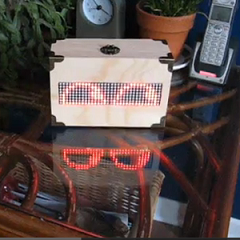
Project Papydoo – LED Matrix + Vibration Sensor
Posted April 1, 2012 by Chris
“Normally, Papydoo is asleep. The enclosure sits on top of a vibration sensor. Papydoo is waken up by a sufficiently strong vibration. Two eyes are then displayed on the LED matrix, wandering randomly around. After a few seconds with no vibration detected, the eyes close and Papydoo goes back to sleep.”

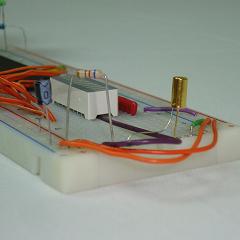
Using A Simple Tilt Sensor
Posted March 8, 2012 by Chris
“In this article we will build an example system and use the basic tilt sensor as an input into a microcontroller. The microcontroller will read the data input from the tilt sensor and act accordingly to output the current state of the tilt sensor. Everything will be done on a breadboard to show how easy it is to assemble and use the system.”
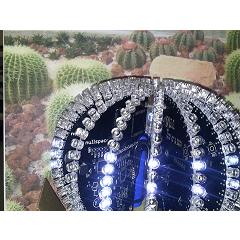
An AVR LED Blinky Ball
Posted February 22, 2012 by Chris
“Description: This spectaculously amazorbing ball that will mesmerise all who look at it, caturday will no longer be the same ! The Specs: There are 384 LEDs all individually controllable and programmable, it is compatible with the freely available Arduino IDE and AVR Studio, comes with sample source code and patterns to get you started, as well as being preprogrammed for instant blinky fun.”

Mandelbrot Set In Real-Time In VGA
Posted February 6, 2012 by Chris
“Along the lines of ‘high-performance’ computation, I have collaborated with Joshua Wise to write (in Verilog) logic to draw a Mandelbrot set in real-time on a VGA monitor. The Mandelbrot set is a connected set of points in the complex plane that depends on an infinite iterative process to determine whether each point is in the set. At each iteration, the original starting point is added to the (complex) square of the previous point.”
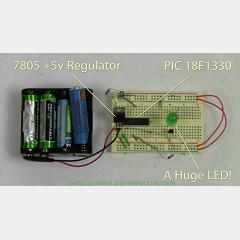
Fading LEDs via PWM
Posted January 19, 2012 by Chris
A very neat feature that PWM (pulse with modulation) offers is being able to control the brightness level of LEDs. By varying the duty cycle percentage, we can control the exact brightness of any LED. This article takes you through a simple example design step-by-step using a PIC microcontroller. The end result is an LED controller that can set an LED to 100 unique brightness levels.
Currently Hot

How To Build An 8x8x8 LED Cube
build an 8x8x8 led cube to mezmorize your friends

Simple RF Receiver And Transmitter @ 27 MHz
build a simple 27 mhz receiver module

Simple 27 MHz RF Transmitter
build a simple rf transmitter with very few parts

Multi Servo Control Using Arduino UNO
control many servos at once using arduino uno

Fading LED Heart Birthday Present
an led heart as a simple birthday present
Animatronics

Recent Articles

Arduino DDS Shield
build your own arduino based analog signal generator

A Digital Multimeter In Review (Tenma 72-7735)
learn about your typical digital multimeter in review

The PIC Annoy PCB
build something to annoy your co-workers

Automate Your Life With Cron
learn how to use cron for computer automation

Web Scraping For Weather Updates
learn how to use php to scrape the web

Creating A Web Server In Linux
learn how to make a lamp web server in linux

Stepper Motor Control With A stepRocker TMCM-1110
learn how a commercial stepper motor controller works

Arduino To PIC Wireless Proximity Motor Control
control a motor with a distance sensor wirelessly

PIC to Arduino Wireless Communication via XBee
use xbee to make a pic wirelessly talk to an arduino

Motor Control via Infrared Distance Sensor
control a motor simply by waving your hand

