



Get started learning to build your own electronics by following our FREE online courses below!
Learn More »
Categories
- animatronics (12)
- apple (11)
- arduino (179)
- art (41)
- articles (121)
- artificial intelligence (11)
- automation (421)
- avr (205)
- bitcoin (3)
- breadboard (9)
- cameras (57)
- cars (26)
- cell phones (28)
- clothing mods (21)
- console mods (26)
- dangerous (94)
- desktop mods (24)
- embedded (5)
- flying things (54)
- fpga (22)
- gaming creations (108)
- interface (225)
- internet (17)
- laptop mods (6)
- lasers (22)
- linux (7)
- magnetic (3)
- medical (12)
- microcontrollers (51)
- misc projects (152)
- msp (12)
- music (124)
- pic (90)
- projects (23)
- pyroedu (76)
- raspberry pi (26)
- robots (312)
- security (36)
- sensors (307)
- software (200)
- solar (19)
- stamp (9)
- tools (149)
- tutorials (98)
- Uncategorized (45)
- usb (44)
- wireless (256)
Sponsors
Build Like A Pyro!
Find many of the parts used on this site at our favorite online electronics shop


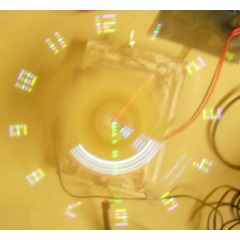
Wireless Persistence of Vision Device with Realtime Control
Posted December 7, 2014 by Chris
"In deciding on a project we looked for a challenge that would have a good mix of hardware and software problems. We ended up primarily concentrating on looking at unusual display technologies and decided that a persistence of vision(POV) display would be a good balance."
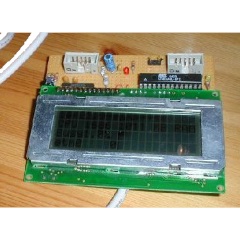
HD44780 LCD To USB
Posted December 5, 2014 by Chris
"LCD2USB is a open source/open hardware project. The goal of LCD2USB is to connect HD44780 based text LCD displays to various PCs via USB. LCD2USB was meant to be cheap and to be made of easily available parts. It is therefore based on the Atmel AVR Mega8 CPU and does not require any difficult to obtain parts like separate USB controllers and the like."
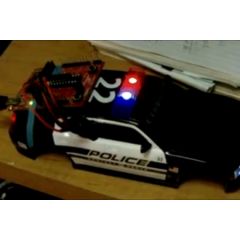
Every Police Car needs flashing lights
Posted December 4, 2014 by Chris
"This weekend didn’t afford me enough time for personal projects, but I did have a few moments to solder connections onto the LED system on the RC police car I’ve been modifying."

Bluetooth Controlled R/C Model Car
Posted December 3, 2014 by Chris
"I’ve simply connected the UART of the bluetooth module to the built-in UART module in ATTiny2313 so they can communicate directly with one-another. A portion of PORTB is used to control the various functions in the model car. The ATtiny2313 firmware goes through a loop which consists of reading the UART, and then setting the outputs and servo position."
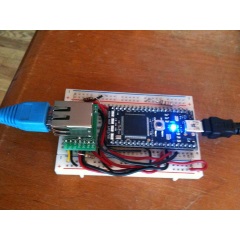
Open Sound Control on mbed microcontroller
Posted November 26, 2014 by Chris
"For independent study in MAT this quarter I sought to implement the Open Sound Control protocol on the mbed. This involved getting UDP send and receive working on mbed and then setting up a parsing / callback system that can take an incoming message and delegate it to the proper subsystem. "
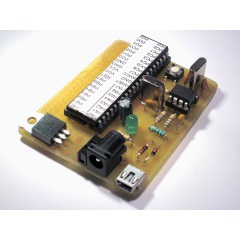
USB6 ABV Platform
Posted November 25, 2014 by Chris
"Like the Arduino, the USB6 allows you to control robots, make electronic instruments, talk to sensors and interface with the internet. The main difference is that you *buy* an Arduino. You make a USB6. This is good for people who are more interested in the hardware side of things. For example, would you like to learn what capacitors look like? Would you like to try out some board etching techniques, especially alternatives to Ferric Chloride, like Hydrogen Peroxide, etc?"
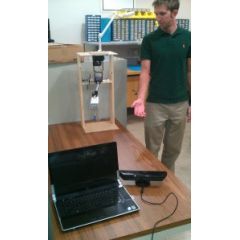
Robotic Arm with Kinect Interface
Posted November 24, 2014 by Chris
"To put it simply, it’s a robot arm that copies you. Think motion capture, but the results you see in real time on hardware…I did not build this thing in mind with any one specific application. What I wanted was an intuitive interface for controlling a robot. This robot could then be sent out into situations that humans can’t or shouldn’t go. "
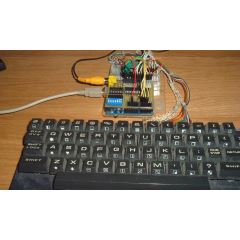
Z80 Single Board Computer
Posted November 21, 2014 by Chris
"OK, it’s made on more one board, but you get the point. Based on Grant’s 7-chip Z80 computer, it uses his modified version of the NASCOM computer version of Microsoft BASIC running from an 8K ROM. The remainder of the Z80’s 64K address space is taken up with 56K of RAM."
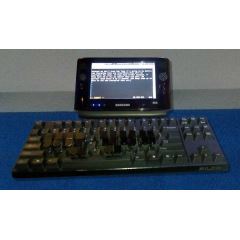
The Open Steno Project
Posted November 20, 2014 by Chris
"Steno technology has existed for about a century, and has been compatible with computers for over 30 years, but until now the hardware and software necessary to write at 240 WPM has been restricted to professional stenographers. The Open Steno Project seeks to bring free software, low-cost hardware, and interactive learning tools to everyone who wants to use steno for their personal or professional pursuits."
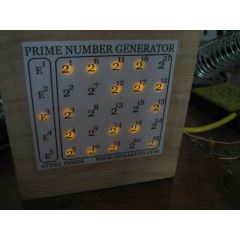
Prime-ary – Prime Number Generator
Posted November 18, 2014 by Chris
"For the last several weeks I’ve been hacking together a small prototype of a microcontroller (ATTiny2313)-powered prime number generator. I can finally say that it is complete, functional, and elegant. The name says what it does, so I won’t waste time describing it."
Currently Hot

Homemade PCB (Etching)
build a pcb board with your bare hands

Simple Motor Optical Encoder
build a simple-low cost optical encoder

Intro To Digital Timers
learn about digital timers and the pic

Personal G-Force Meter
make your own personal g-force meter

VHDL Keyboard Input
use vhdl to interface a cpld to a keyboard
Animatronics

Recent Articles

Arduino DDS Shield
build your own arduino based analog signal generator

A Digital Multimeter In Review (Tenma 72-7735)
learn about your typical digital multimeter in review

The PIC Annoy PCB
build something to annoy your co-workers

Automate Your Life With Cron
learn how to use cron for computer automation

Web Scraping For Weather Updates
learn how to use php to scrape the web

Creating A Web Server In Linux
learn how to make a lamp web server in linux

Stepper Motor Control With A stepRocker TMCM-1110
learn how a commercial stepper motor controller works

Arduino To PIC Wireless Proximity Motor Control
control a motor with a distance sensor wirelessly

PIC to Arduino Wireless Communication via XBee
use xbee to make a pic wirelessly talk to an arduino

Motor Control via Infrared Distance Sensor
control a motor simply by waving your hand

