



Get started learning to build your own electronics by following our FREE online courses below!
Learn More »
Categories
- animatronics (12)
- apple (11)
- arduino (179)
- art (41)
- articles (121)
- artificial intelligence (11)
- automation (421)
- avr (205)
- bitcoin (3)
- breadboard (9)
- cameras (57)
- cars (26)
- cell phones (28)
- clothing mods (21)
- console mods (26)
- dangerous (94)
- desktop mods (24)
- embedded (5)
- flying things (54)
- fpga (22)
- gaming creations (108)
- interface (225)
- internet (17)
- laptop mods (6)
- lasers (22)
- linux (7)
- magnetic (3)
- medical (12)
- microcontrollers (51)
- misc projects (152)
- msp (12)
- music (124)
- pic (90)
- projects (23)
- pyroedu (76)
- raspberry pi (26)
- robots (312)
- security (36)
- sensors (307)
- software (200)
- solar (19)
- stamp (9)
- tools (149)
- tutorials (98)
- Uncategorized (45)
- usb (44)
- wireless (256)
Sponsors
Build Like A Pyro!
Find many of the parts used on this site at our favorite online electronics shop


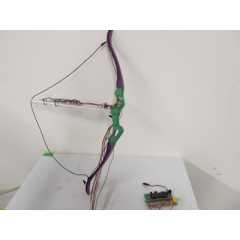
Virtual Archery ATMEGA Style
Posted April 7, 2013 by Chris
“We decided to create a virtual archery game for our ECE 4760 final project. This game consists of an ATmega1284P microcontroller, a TV for display, and multiple pieces of hardware. All of these devices communicate together to simulate a three-round game of archery with a target that is 20 feet away from the user.”

PIC Micro Programming Pen
Posted April 6, 2013 by Chris
“…when you have to program many chips, repeatedly reconnecting the programming cable quickly becomes a chore. So when I found an article about constructing a programming pen that would help solve both of these problems, I decided to build one for myself…”
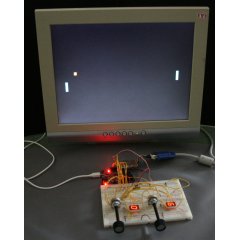
VGA Pong with the ChipKIT Uno32
Posted April 5, 2013 by Chris
“My code uses some features of the Arduino software suite and some of the low-level hardware code derived from the PIC headers. This allows rapid development of the slow user-interface parts of the system (control input and score display) whilst allowing the video generation in real time by using the low-level hardware controls.”

Learn About Digital Logic Gates – PyroEDU Lesson 3 Now Live!
Posted April 4, 2013 by Chris
Last week we introduced you to the Binary and Decimal number systems in our new course: An Introduction To Digital Electronics. This week, we’ll continue forward using binary with digital logic in Lesson 3: Logic Gates. Here is what this week’s lesson is all about:
The fundamental representation of digital hardware comes in a symbol form, called logic gates. These gates perform boolean algebra in a visual way that leads to what are called logic diagrams. In this lesson, we’ll learn the basic logic gates of digital electronics and experiment with them to make sure they do what they should.

Cardboard Plotter
Posted April 3, 2013 by Chris
“When I gave a workshop at the School of Art and Design in Offenbach about building digital devices out of cardboard, the students asked me to build a machine as well. I always wanted to own a plotter – so I didn’t have to think too long about what exactly I’d build.”

Urban Tapestries – Feral Robot Client Architecture
Posted April 2, 2013 by Chris
“This report provides technical documentation for a prototype mobile environmental sensor that integrates with the Urban Tapestries public authoring system — the Feral Robot, version 2. Descriptions of the main requirements, as well as the steps in the hardware/software platform development are presented.”
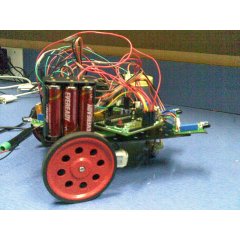
Building A Collision Avoidance Robot
Posted April 1, 2013 by Chris
“The robot starts moving automatically each time when the reset switch is pressed, the robot itsself finds an obstacle free path using the IR SENSORS. Whenever an obstacle appears, the robot changes its direction to avoid the obstacle and continue on its path.”

DIY Tengu On A Breadboard
Posted March 31, 2013 by Chris
“When I first saw Crispin Jones Tengu, I was sure, I must have one. If you don’t know tengu and don’t want to follow the link, it’s a small face, made of LEDs, that reacts to music and sound.
It did not take long until I decided to clone this funny little device. All it needs is a microcontroller, an LED matrix and a sound sensor.”

LED Matrix Link: Prototype
Posted March 30, 2013 by Chris
“I noticed that most LED Matrix drivers on the market use shift registers to give a microcontroller the ability to control more LEDs than would be possible. Last year I came across the MAX7219 from Maxim Integrated. This cool little IC does all the work for you to drive a LED Matrix or LED Segment display.”

DIY Musical Keyboard (With Discrete Logic)
Posted March 29, 2013 by Chris
“The idea is to design and construct an electronic musical keyboard with some functions, effects etc,. This is my old school project and I remade and modified it. There are many hobbyist’s musical keyboard circuits around the net. Most design are based on 555 or some oscillator circuits. The limitation of these design are that this circuit generates only one tone at a time.”
Currently Hot

The Stunning Camera
shock your friends when they take your picture

A Simple File Server
make a file server on your pc

A Simple VHDL Counter
create a simple counter using vhdl with a cpld

An Introduction To VHDL
a small tutorial on using vhdl with a cpld

The Autonomous Drifter
autonomous drifter controlled by your laptop
Animatronics

Recent Articles

Arduino DDS Shield
build your own arduino based analog signal generator

A Digital Multimeter In Review (Tenma 72-7735)
learn about your typical digital multimeter in review

The PIC Annoy PCB
build something to annoy your co-workers

Automate Your Life With Cron
learn how to use cron for computer automation

Web Scraping For Weather Updates
learn how to use php to scrape the web

Creating A Web Server In Linux
learn how to make a lamp web server in linux

Stepper Motor Control With A stepRocker TMCM-1110
learn how a commercial stepper motor controller works

Arduino To PIC Wireless Proximity Motor Control
control a motor with a distance sensor wirelessly

PIC to Arduino Wireless Communication via XBee
use xbee to make a pic wirelessly talk to an arduino

Motor Control via Infrared Distance Sensor
control a motor simply by waving your hand

