



Get started learning to build your own electronics by following our FREE online courses below!
Learn More »
Categories
- animatronics (12)
- apple (11)
- arduino (179)
- art (41)
- articles (121)
- artificial intelligence (11)
- automation (421)
- avr (205)
- bitcoin (3)
- breadboard (9)
- cameras (57)
- cars (26)
- cell phones (28)
- clothing mods (21)
- console mods (26)
- dangerous (94)
- desktop mods (24)
- embedded (5)
- flying things (54)
- fpga (22)
- gaming creations (108)
- interface (225)
- internet (17)
- laptop mods (6)
- lasers (22)
- linux (7)
- magnetic (3)
- medical (12)
- microcontrollers (51)
- misc projects (152)
- msp (12)
- music (124)
- pic (90)
- projects (23)
- pyroedu (76)
- raspberry pi (26)
- robots (312)
- security (36)
- sensors (307)
- software (200)
- solar (19)
- stamp (9)
- tools (149)
- tutorials (98)
- Uncategorized (45)
- usb (44)
- wireless (256)
Sponsors
Build Like A Pyro!
Find many of the parts used on this site at our favorite online electronics shop


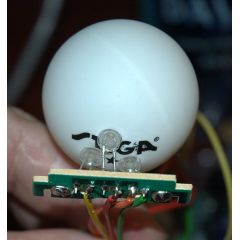
RGB LED Ping Pong Ball Light
Posted July 12, 2014 by Chris
"I did some more scrounging to create a mini Locnar using the LEDs from a Glade Light Show air freshener. The wall wart had previously been scrounged from this air freshener for the bread board power supply. Now we reuse part of the circuit board with the LEDs combined with what we learned in the Ping Pong Ball diffuser project to create a color changing orb."

In-Circuit Conduction Tester
Posted July 11, 2014 by Chris
"This is a conduction tester to check the connection on the built proto-board. Normally a circuit tester is used to check the conduction. But it is not suitable to check if wired or not in the circuit board with mounted parts because the semiconductor parts in the circuit become conductive under test voltage."

Digital Stethoscope – Electronic Auscultation Device
Posted July 8, 2014 by Chris
"The purpose of this project was to design and implement a digital stethoscope to serve as a platform for potential computer aided diagnosis applications for the detection of cardiac murmurs. The system uses a custom-built sensor to capture heart sounds at 8 kHz and converts them to electrical signals to be processed by an ATmega644 microcontroller."
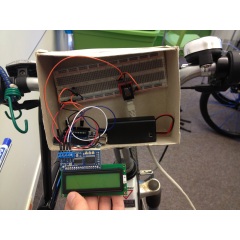
My Bicycle Computer
Posted July 7, 2014 by Chris
"My first Physical Computing class assignment for this summer was to create a bicycle computer. This is a device that you stick on your bike and it tells you how fast you are going, what your speed is, etc. Following is how I made my own bicycle computer."

The HangBot Project
Posted July 5, 2014 by Chris
"Each anchor is connected to a motorshield via Ethernet cables and the shield is mounted to an Arduino. I located a copy of the firmware on Github and started editing it with AVR Studio. Once I implemented the necessary geometry modifications, I used a program called XLoader to flash the new firmware over to the Atmel chip."

Intro to FPGA and CPLD: Lesson 2 Live!
Posted July 3, 2014 by Chris
This week we’re moving on to Lesson 2: Hardware Hello world in our new PyroEDU course: An Introduction to CPLD and FPGA. Here’s an overview of the lesson:
"Building a ‘hello world’ application signifies a time honored approach to learning how to program. In this lesson, we will explore the first steps necessary for building and loading images onto a CPLD."

2-sided Bicycle POV
Posted July 2, 2014 by Chris
"The MiniPOV uses only a single PIC16F630 while the spoke uses an Amtel micro-controller, an EEPROM, and several 74×259 8-bit latches. I wanted to enhance the MiniPOV to display text on both sides of the bike wheel. I chose to use Microchip’s PIC because they sold a cheap programmer.."
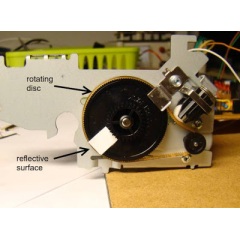
Contactless Tachometer Using PIC16F628A
Posted June 30, 2014 by Chris
"Contact-less measurement of RPM will be achieved through an IR sensor. An IR diode will send a beam of infrared towards the rotating disc, and any reflected pulse will be received by a photo diode. The resistance of a photo diode drops drastically when exposed to infrared. An infrared is reflected by a white surface and absorbed by the dark ones."

CPLD Programming: What is JTAG?
Posted June 29, 2014 by Chris
"Here we will discuss The ‘JTAG’ IEEE 1532 standard used for ‘ISP’ (In-System-Programming) I will also talk about Atmel’s ‘AVR ISP’ programmer and it’s ‘SPI’ (Serial-Peripheral-Interface)."
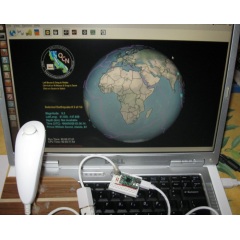
Using a Wii Nunchuk as an Earthquake Sensor
Posted June 28, 2014 by Chris
"This article explores the suitability of a Wii nunchuk based USB accelerometer as an earthquake sensor for the Quake-Catcher Network (QCN) project. It examines the nunchuk over several metrics: precision and range, frequency response, total cost and availability."
Currently Hot

How To Build An 8x8x8 LED Cube
build an 8x8x8 led cube to mezmorize your friends

Simple RF Receiver And Transmitter @ 27 MHz
build a simple 27 mhz receiver module

Simple 27 MHz RF Transmitter
build a simple rf transmitter with very few parts

Multi Servo Control Using Arduino UNO
control many servos at once using arduino uno

Fading LED Heart Birthday Present
an led heart as a simple birthday present
Animatronics

Recent Articles

Arduino DDS Shield
build your own arduino based analog signal generator

A Digital Multimeter In Review (Tenma 72-7735)
learn about your typical digital multimeter in review

The PIC Annoy PCB
build something to annoy your co-workers

Automate Your Life With Cron
learn how to use cron for computer automation

Web Scraping For Weather Updates
learn how to use php to scrape the web

Creating A Web Server In Linux
learn how to make a lamp web server in linux

Stepper Motor Control With A stepRocker TMCM-1110
learn how a commercial stepper motor controller works

Arduino To PIC Wireless Proximity Motor Control
control a motor with a distance sensor wirelessly

PIC to Arduino Wireless Communication via XBee
use xbee to make a pic wirelessly talk to an arduino

Motor Control via Infrared Distance Sensor
control a motor simply by waving your hand

