



Get started learning to build your own electronics by following our FREE online courses below!
Learn More »
Categories
- animatronics (12)
- apple (11)
- arduino (179)
- art (41)
- articles (121)
- artificial intelligence (11)
- automation (421)
- avr (205)
- bitcoin (3)
- breadboard (9)
- cameras (57)
- cars (26)
- cell phones (28)
- clothing mods (21)
- console mods (26)
- dangerous (94)
- desktop mods (24)
- embedded (5)
- flying things (54)
- fpga (22)
- gaming creations (108)
- interface (225)
- internet (17)
- laptop mods (6)
- lasers (22)
- linux (7)
- magnetic (3)
- medical (12)
- microcontrollers (51)
- misc projects (152)
- msp (12)
- music (124)
- pic (90)
- projects (23)
- pyroedu (76)
- raspberry pi (26)
- robots (312)
- security (36)
- sensors (307)
- software (200)
- solar (19)
- stamp (9)
- tools (149)
- tutorials (98)
- Uncategorized (45)
- usb (44)
- wireless (256)
Sponsors
Build Like A Pyro!
Find many of the parts used on this site at our favorite online electronics shop


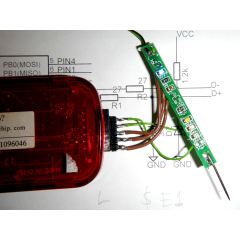
LOpen – PIC10F202 controlled Logic Pen
Posted September 7, 2014 by Chris
"This time it’s a Logic Pen controlled by a tiny 6-pin PIC10F202. The PCB is 5 cm by 5mm so it fits just fine inside a regular ballpoint pen and have 5 leds (1 power led and 4 controllable from the PIC), over voltage protection on the probe input, reverse polarity protection using a p-fet."
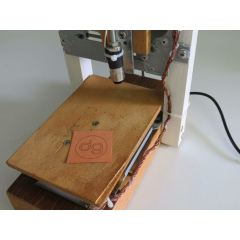
Laser Engraver build using CD-ROM/Writer
Posted September 5, 2014 by Chris
"To build this tool I’ve used two old CD-ROM writer that lays around in my garage.
The X/Y positioning system it is build using the CD-ROM motor assembly. For the engraving laser I use the CD-ROM writer laser. With this hardware the engraving area are will be almost 38mm x 38mm."
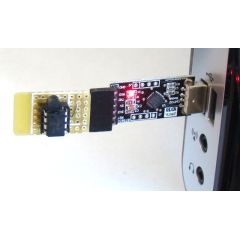
Low cost temperature data logger using PIC and Processing
Posted September 3, 2014 by Chris
"This project describes an easy and inexpensive way of adding a digital thermometer and data logging feature to a PC. It involves a PIC microcontroller that gets the surrounding temperature information from the Microchip MCP9701 sensor, and sends it to a PC through an USB-UART interface."

Make an Encoder for your Bot
Posted September 2, 2014 by Chris
"Here is a method for making an encoder with two sensors for your application. If you only need speed sensing, you may want to skip down to the construction section. The important variables are the radius of the circle (r), the distance between the two optical sensors (s), and the number of divisions in the wheel (d). …."
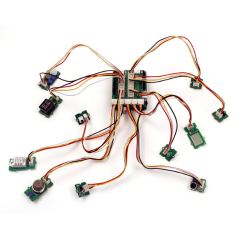
WireGarden – Sensor Interface
Posted September 1, 2014 by Chris
"WireGarden is a simplified way to interact with sensors and other hardware. It is based on the Arduino platform. The WireGarden system has four main parts: Hardware, Arduino Software, Communication and User Software."
How Do I FPGA? A Quick Intro
Posted August 31, 2014 by Chris
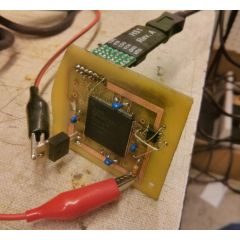
"Not wanting to screw up an expensive complex board by being a first-timer at putting an FPGA into a circuit, I figured I’d build a little test board with the cheapest Spartan 6 you can get (about $10), which comes in a solderable TQFP144 package. Sadly, most high end FPGA’s are BGA and therefore quite hard to solder as a DIY project."
UV Light Box
Posted August 30, 2014 by Chris
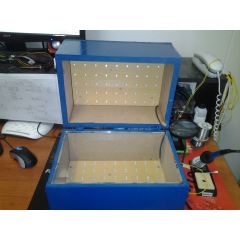
"Probably the most indispensable tool for making printed circuit boards, is the UV light box. There are a couple of different methods for transferring of a PCB image. The most common homemade method, seems to be the toner transfer method, judging by the number of sites describing it. However, I use the photo lithography method and I have had great results with it so far, so no need to change."
Room Temperature Sensor (Automation)
Posted August 29, 2014 by Chris
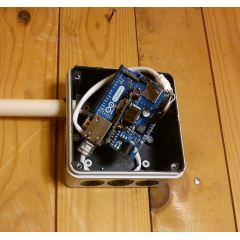
"Abstract: Measure the temperature with one or more LM35DZ or DS18B20 temperature sensors, and then publishes the result when the value changes or every 20min. There is also a alarm function when the value goes higher/lower than the alarm limits."

VHDL vs Verilog vs Schematic – New CPLD PyroEDU Lesson!
Posted August 28, 2014 by Chris
This week, we’re finishing off An Introduction to CPLD and FPGA with Lesson 10: VHDL vs Verilog vs Schematic. Here’s a short overview of the lesson:
"There are many ways to create a CPLD or FPGA image. The most common methods are with VHDL, Verilog or schematic capture. In this lesson we’ll explore and compare all three."

Wireless Infrared Stepper Motor Controller
Posted August 26, 2014 by Chris
"The stepper motors are 6 wire unipolar steppers that are controlled by a TI SN754410NE H-Bridge that is connected to a PIC 16fF84 microcontroller. The PIC sends pulses to the H-Bridge that move the motor in 1 degree/step increments in either a clockwise or counter clockwise direction. An infrared detector is used to sense IR pulses sent by the TV remote control."
Currently Hot

Fading LED Heart Birthday Present
an led heart as a simple birthday present

Arduino VGA Output Using Timer Interrupts
output vga from an arduino using timer interrupts

Arduino Servo Motor Controller
control a servo motor using an arduino uno
An Arduino Outputting VGA Signals
output some basic vga using an arduino uno

Super Simple Arduino Tachometer
build an arduino tachometer and measure rpms
Animatronics

Recent Articles

Arduino DDS Shield
build your own arduino based analog signal generator

A Digital Multimeter In Review (Tenma 72-7735)
learn about your typical digital multimeter in review

The PIC Annoy PCB
build something to annoy your co-workers

Automate Your Life With Cron
learn how to use cron for computer automation

Web Scraping For Weather Updates
learn how to use php to scrape the web

Creating A Web Server In Linux
learn how to make a lamp web server in linux

Stepper Motor Control With A stepRocker TMCM-1110
learn how a commercial stepper motor controller works

Arduino To PIC Wireless Proximity Motor Control
control a motor with a distance sensor wirelessly

PIC to Arduino Wireless Communication via XBee
use xbee to make a pic wirelessly talk to an arduino

Motor Control via Infrared Distance Sensor
control a motor simply by waving your hand

