



Get started learning to build your own electronics by following our FREE online courses below!
Learn More »
Categories
- animatronics (12)
- apple (11)
- arduino (179)
- art (41)
- articles (121)
- artificial intelligence (11)
- automation (421)
- avr (205)
- bitcoin (3)
- breadboard (9)
- cameras (57)
- cars (26)
- cell phones (28)
- clothing mods (21)
- console mods (26)
- dangerous (94)
- desktop mods (24)
- embedded (5)
- flying things (54)
- fpga (22)
- gaming creations (108)
- interface (225)
- internet (17)
- laptop mods (6)
- lasers (22)
- linux (7)
- magnetic (3)
- medical (12)
- microcontrollers (51)
- misc projects (152)
- msp (12)
- music (124)
- pic (90)
- projects (23)
- pyroedu (76)
- raspberry pi (26)
- robots (312)
- security (36)
- sensors (307)
- software (200)
- solar (19)
- stamp (9)
- tools (149)
- tutorials (98)
- Uncategorized (45)
- usb (44)
- wireless (256)
Sponsors
Build Like A Pyro!
Find many of the parts used on this site at our favorite online electronics shop


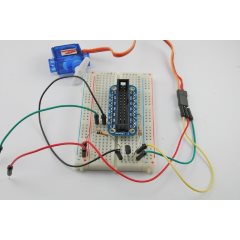
Raspberry Pi GPIO driving Servo
Posted March 9, 2016 by Chris
"I have experimented with GPIO on the Raspberry Pi, just turning an LED on and off here. But since then Ben Croston has improved the RPi GPIO Python library to do most of the work in C and I can confirm that it is a lot faster. Driving servo motors requires precise timing, so I decided to see how the Pi would perform this task."

Happy Days or Staging Beckett with 11 motors
Posted March 7, 2016 by Chris
"Happy Days is exploring narrative in the form of an installation. It is staged without human actors or conventional (verbal) dialogue in a non-theatrical space. We chose to stage Samuel Beckett’s Happy Days since, as performing a ritual in the play, overshadows the performer, the object of the ritual can survive on its own."
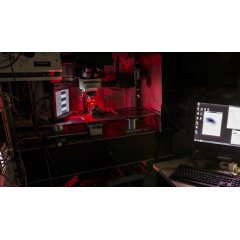
Intrinsic Optical Signal Imaging Chamber IOSIC
Posted March 5, 2016 by Chris
"Intrinsic optical signal (IOS) imaging is a functional imaging technique that has revolutionized our understanding of cortical functional organization and plasticity since it was first implemented, around 30 years ago. Even if IOS imaging lacks the ability to directly measure electrical neuronal function and track data at a fine temporal scale, it has some advantages on electrophysiological techniques, such as the capability to visualize functional architectures via the simultaneous sampling of a large cortical region with high spatial resolution."
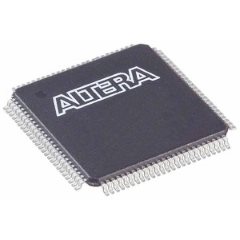
eLearning Series: Getting started with CPLDs
Posted March 3, 2016 by Chris
"Here you will find links to all the articles that make up our CPLD for beginners guide. We’d love to hear your feedback about this guide. If we’ve got something wrong or if there’s anything specific you’d like us to cover, please don’t hesitate to get in touch."
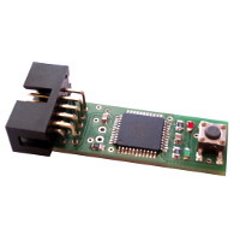
ISPnub – Stand-alone AVR In-System-Programmer Module
Posted March 1, 2016 by Chris
"ISPnub is a simple to use stand alone programmer intended for flashing AVR controllers in the field directly in the target system or during production. The module has only one button and two leds as user interface."
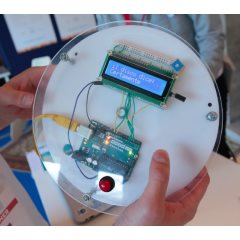
How To Write A Library For Arduino
Posted February 21, 2016 by Chris
"Libraries are files written in C or C++ which provide sketches with extra functionality, for example the ability to control an LED matrix, read an encoder, connect to a sensor, display, or module, etc. They are very useful to lower the barriers for creating amazing interactive projects and use a wide range of components. Libraries can be created by everyone and shared with the open source community!"
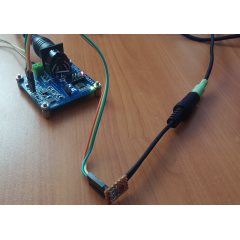
Polyphonic FM Synthesizer with STM32F031
Posted February 17, 2016 by Chris
"I’ve built a playable, MIDI capable, polyphonic FM synthesizer using an 32bit ARM Cortex M0 microcontroller and an audio codec. This was a learning experience for me. You can find the finished form of the system in following two images."
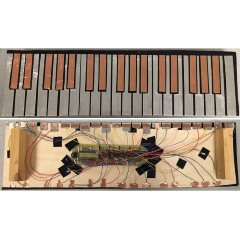
Capacitive Touch Piano
Posted February 15, 2016 by Chris
"Our project designs a touch piano with 3 octaves (37 keys) by connecting a handmade piano-like touch-sensitive keyboard with a PIC32 microcontroller. The sound is generated by using Karplus-Strong algorithm with debounce function and with a sensitive reaction time of several hundred microseconds."
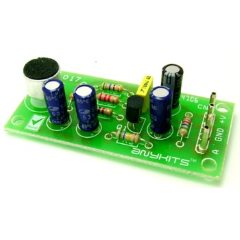
Tiny Mic Pre-Amplifier
Posted February 13, 2016 by Chris
"The Tiny Mic Preamplifier based is based on a single transistor amplifier design. It amplifies the output of the electret condenser microphone. Good choice for Karaoke."
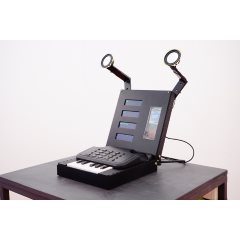
Prankophone with Synthesizer
Posted February 11, 2016 by Chris
"Prankophone is a sound object being a hybrid of synthesizer, telephone and logic module. The main principle of the object’s functioning is as follows: depending on the current mode, the apparatus calls to random or pre-defined recipients and plays them algorithmic melodies created from their phone numbers. The speakers transmit both the synthesized sounds and the sound from answering person."
Currently Hot

Programming the eBOX
create & download an os image to the eBOX-II

The Altera DE2 Board
a simple introduction for setting up the DE2 board
The eBOX-II Embedded PC
learn the in's and out's of the eBOX-II

Stepper Motor Control
control a stepper motor using an LMD18245

PIC Prototyping Basics
build your own pic prototype development board
Animatronics

Recent Articles

Arduino DDS Shield
build your own arduino based analog signal generator

A Digital Multimeter In Review (Tenma 72-7735)
learn about your typical digital multimeter in review

The PIC Annoy PCB
build something to annoy your co-workers

Automate Your Life With Cron
learn how to use cron for computer automation

Web Scraping For Weather Updates
learn how to use php to scrape the web

Creating A Web Server In Linux
learn how to make a lamp web server in linux

Stepper Motor Control With A stepRocker TMCM-1110
learn how a commercial stepper motor controller works

Arduino To PIC Wireless Proximity Motor Control
control a motor with a distance sensor wirelessly

PIC to Arduino Wireless Communication via XBee
use xbee to make a pic wirelessly talk to an arduino

Motor Control via Infrared Distance Sensor
control a motor simply by waving your hand

