



Get started learning to build your own electronics by following our FREE online courses below!
Learn More »
Categories
- animatronics (12)
- apple (11)
- arduino (179)
- art (41)
- articles (121)
- artificial intelligence (11)
- automation (421)
- avr (205)
- bitcoin (3)
- breadboard (9)
- cameras (57)
- cars (26)
- cell phones (28)
- clothing mods (21)
- console mods (26)
- dangerous (94)
- desktop mods (24)
- embedded (5)
- flying things (54)
- fpga (22)
- gaming creations (108)
- interface (225)
- internet (17)
- laptop mods (6)
- lasers (22)
- linux (7)
- magnetic (3)
- medical (12)
- microcontrollers (51)
- misc projects (152)
- msp (12)
- music (124)
- pic (90)
- projects (23)
- pyroedu (76)
- raspberry pi (26)
- robots (312)
- security (36)
- sensors (307)
- software (200)
- solar (19)
- stamp (9)
- tools (149)
- tutorials (98)
- Uncategorized (45)
- usb (44)
- wireless (256)
Sponsors
Build Like A Pyro!
Find many of the parts used on this site at our favorite online electronics shop



PyroEDU Lesson 8 – The OpAmp – Now Live!
Posted December 13, 2012 by Chris
Last week, we learned more about The Transistor, the 7th lesson of the first PyroEDU course: An Introduction To Modern Electronics. This week we’re introducing a more complex integrated circuit: The OpAmp.
Moving beyond single device components we have the operational amplifier. This device is actually a combination of special transistors and other components all put inside an IC package. This lesson will perform a few experiments, look at some mathematical theory to introduce you to the many functions of the op-amp.

Driving A Stepper Motor Directly From A PIC
Posted December 12, 2012 by Chris
“Much has been written about driving stepper motors. Some sites say it’s easy. Some people say it’s hard. Some people say you have to get the timing and the sequence right, some people say it’s more hassle than it’s worth and you should just buy a stepper driver board! We’ve spent just a few hours today playing about with our stepper motor and found it’s quite straight forward – provided you follow each step slowly and carefully.”
(Very similar to our own Stepper Motor Control article.)

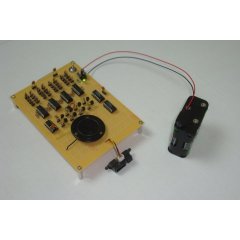
How To Build A Simple IR Theremin
Posted December 11, 2012 by Chris
“In this article, we will explore how to translate analog voltages from an IR proximity sensor into digital information that we can use to determine distance away from an object. Depending on how far away the object is, a different tone can be heard.”
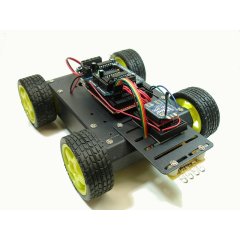
Wireless Robotics Platform with XBee Remote Control
Posted December 10, 2012 by Chris
“I built a remote-controlled robotics platform using a 4WD mobile platform, an Arduino (Seeeduino Mega), an Adafruit motor shield, and two XBee radios for communication. There are also some super-bright white LEDs on the front for headlights. The point of the project was to show how an XBee radio can be used to send joystick sensor data without using a microcontroller on the remote.”

Proximity Security System (Keyless Entry)
Posted December 9, 2012 by Chris
“For our final project, we designed and built an RFID-based proximity security system for use with Cornell Identification cards, which have been RFID-embedded since fall of 2003. The idea for this project was sort of spawned from our general interest in RFID technologies and the near-simultaneous occurance of Lab 2 and the antiquated lock system at our fraternity house breaking.”

AVR Mod Player
Posted December 8, 2012 by Chris
“My idea was to use an oscilloscope as the video output device to show some vector graphics, and create a mod player to provide the audio. The video part of the project had some design flaws and terrible noise in the DACs so I never really finished that part. Also, the audio part was much more fun. The modplayer was built using an ATmega325, a 4MBit flash memory and an op-amp to amplify the audio.”

PIC 18F4550 Real-Time Audio Spectrum Analyzer
Posted December 7, 2012 by Chris
“This project implements a real-time audio spectrum analyser using a PIC18F4550 8-bit microcontroller. The spectrum frequency analysis is performed by a highly optimised 16-bit Fast Fourier Transformation (FFT) routine coded entirely in C. The output from the FFT is displayed using a 128×64 graphical LCD to allow a real-time view of an audio signal.”
PyroEDU Lesson 7 – The Transistor – Now Live!
Posted December 6, 2012 by Chris
Last week, we learned more about The Diode, the 6th lesson of the first PyroEDU course: An Introduction To Modern Electronics. This week we’re introducing the most important electronics component: The Transistor.
Like diodes, most people have heard about transistors, however few people understand what they are and what they can do. This lesson takes a few steps deeper to explain and perform some experiments about how transistors are great electrical on/off switches. A little theory is also explored to introduce you to BJT transistor formulas.

FPGA To PSP LCD Interface With A Spartan 3
Posted December 5, 2012 by Chris
“The following explains the design of a control circuit for the TFT-LCD module LQ043T3DX02 Sharp, best known as the display used in the PlayStation Portable (PSP). It has a 480×272 resolution capable of displaying up to 16 million colors through a data bus 24-bit RGB backlight built.”
(Very similar to our own FPGA ~> PSP LCD Interface article.)
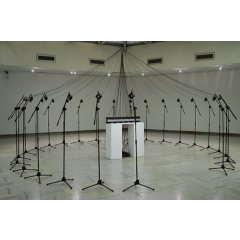
Bzzz! The Sound of Electricity
Posted December 4, 2012 by Chris
“The sculpture has a radial form, arranged around a sound wave generator at the centre of a room surrounded by a set of wall-mounted loudspeakers. The generator is connected to the loudspeakers by a bundle of audio wires running vertically and then branching out to form a sort of tree that shows the pathways of the electrical current.”
Currently Hot

The Stunning Camera
shock your friends when they take your picture

A Simple File Server
make a file server on your pc

A Simple VHDL Counter
create a simple counter using vhdl with a cpld

An Introduction To VHDL
a small tutorial on using vhdl with a cpld

The Autonomous Drifter
autonomous drifter controlled by your laptop
Animatronics

Recent Articles

Arduino DDS Shield
build your own arduino based analog signal generator

A Digital Multimeter In Review (Tenma 72-7735)
learn about your typical digital multimeter in review

The PIC Annoy PCB
build something to annoy your co-workers

Automate Your Life With Cron
learn how to use cron for computer automation

Web Scraping For Weather Updates
learn how to use php to scrape the web

Creating A Web Server In Linux
learn how to make a lamp web server in linux

Stepper Motor Control With A stepRocker TMCM-1110
learn how a commercial stepper motor controller works

Arduino To PIC Wireless Proximity Motor Control
control a motor with a distance sensor wirelessly

PIC to Arduino Wireless Communication via XBee
use xbee to make a pic wirelessly talk to an arduino

Motor Control via Infrared Distance Sensor
control a motor simply by waving your hand

