



Get started learning to build your own electronics by following our FREE online courses below!
Learn More »
Categories
- animatronics (12)
- apple (11)
- arduino (179)
- art (41)
- articles (121)
- artificial intelligence (11)
- automation (421)
- avr (205)
- bitcoin (3)
- breadboard (9)
- cameras (57)
- cars (26)
- cell phones (28)
- clothing mods (21)
- console mods (26)
- dangerous (94)
- desktop mods (24)
- embedded (5)
- flying things (54)
- fpga (22)
- gaming creations (108)
- interface (225)
- internet (17)
- laptop mods (6)
- lasers (22)
- linux (7)
- magnetic (3)
- medical (12)
- microcontrollers (51)
- misc projects (152)
- msp (12)
- music (124)
- pic (90)
- projects (23)
- pyroedu (76)
- raspberry pi (26)
- robots (312)
- security (36)
- sensors (307)
- software (200)
- solar (19)
- stamp (9)
- tools (149)
- tutorials (98)
- Uncategorized (45)
- usb (44)
- wireless (256)
Sponsors
Build Like A Pyro!
Find many of the parts used on this site at our favorite online electronics shop


This Robot Can See Through Walls…Really!
Posted December 26, 2011 by Chris
“In the heart of the D1 radar sensor is a radar chip based on UWB radar technology from Novelda. An UWB radar sensor sends out EM pulses and looks at the pulses that are reflected back. When an EM pulse hits the wall in the video above, a part of the pulse is reflected back to the radar and a part of it penetrates the wall and is reflected from the cabinet behind the wall.”
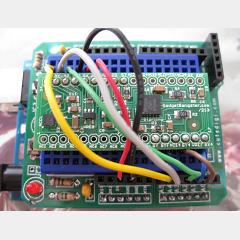
Arduino code for IMU Guide algorithm
Posted December 24, 2011 by Chris
“This article introduces an implementation of a simplified filtering algorithm that was inspired by Kalman filter. The Arduino code is tested using a 5DOF IMU unit from GadgetGangster – Acc_Gyro . The theory behind this algorithm was first introduced in my Imu Guide article.”

AVR Based Digital Thermometer with Nokia 3310 LCD and Thermistor
Posted December 16, 2011 by Chris
“This project shows how to use a simple thermistor to measure temperature and display the temperature graphically on a Nokia 3310 LCD. Thermistors are incredibly cheap (about 50 cents), and provide fractions of a degree accuracy.”
Accurate Ultrasonic Distance Measurement
Posted October 25, 2011 by Chris
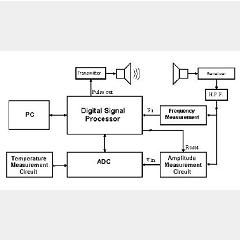
“This paper introduces a different approach to the measurement of the time-of-flight of ultrasonic signals. Frequency variation monitoring and recording is used to determine accurately the arrival time of the ultrasonic signal. A high speed D.S.P. is used for both: transmission and direct measurement of the frequency of the incoming signal in every single period and with an accuracy of about 0.1%.”
PIC16F648 GPS Logger
Posted October 5, 2011 by Chris
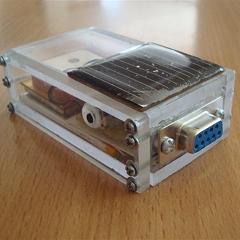
Another data logger! This one uses a PIC to load GPS points into an EEPROM and when you’re done you can unload the points into your PC through a serial port, put them into google maps and get a map of where you (or the data logger) traveled. Would be cool to put one of these into the mail and see how efficient the mail system is. The article is in dutch so use google translate for english.
An Inkjet Printer Servo System
Posted September 19, 2011 by Chris
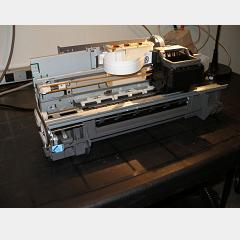
A DC servo motor is a powerful tool if you know how to design it properly. They offer high torque and high precision, something that steppers can’t always offer. This article dis-assembles a standard inkjet printer to show you how to experiment with building a low cost DIY servo system. They even recommend using my 10-A H-Bridge! The article is a two parter, so don’t miss both pages.

Haptic Assisted Locating of Obstacles (HALO)
Posted August 24, 2011 by Chris
Want to add some sonar to your senses? Look no further, the HALO does what you want in true DIY fashion. Using an Arduino as its brain, the HALO connects together a number of ultrasonic sonar sensors to give you feedback about where obstacles are helping you navigate.
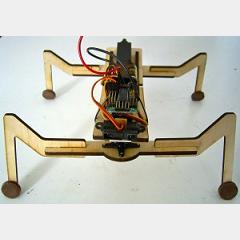
Flatpack Walker With Radar
Posted August 16, 2011 by Chris
Adding a little intelligence to your robot is as simple as adding a proximity sensor. The flatpack walker uses servo motors to walk and the sensor to know when there is something in its way. The software and construction details are all in the article.

Encoder Sensors And Robots
Posted July 4, 2011 by Chris
Encoders are a form of sensor feedback that tell you how far something has moved. As seen in my tutorial: The Digital Tachometer encoders can be based on line-of-sight, reflect off black and white encoder wheels or they can even detect magnetic field changes as a form of movement tracking. This article goes through these types of encoders and explains how you can use them in your robotics projects.

Formerly R/C, Robot Wall Racers
Posted June 30, 2011 by Chris
This article shows how you can take some standard R/C cars, hack away at their guts and make automated racing cars. Two ultrasonic proximity sensors were added to each car so that they can sense their surroundings and a Picaxe micro was added to make the cars intelligent. Check out the action video to see autonomous racing.
Currently Hot

An Arduino Outputting VGA Signals
output some basic vga using an arduino uno

Super Simple Arduino Tachometer
build an arduino tachometer and measure rpms

Arduino 16×2 LCD Interface
display characters on an lcd using your arduino

DE0-Nano FPGA Tilt Sensing
use the de0-nano board to sense tilt and acceleration
DE0-Nano FPGA Breakout Board
build your own custom i/o expander breakout board
Animatronics

Recent Articles

Arduino DDS Shield
build your own arduino based analog signal generator

A Digital Multimeter In Review (Tenma 72-7735)
learn about your typical digital multimeter in review

The PIC Annoy PCB
build something to annoy your co-workers

Automate Your Life With Cron
learn how to use cron for computer automation

Web Scraping For Weather Updates
learn how to use php to scrape the web

Creating A Web Server In Linux
learn how to make a lamp web server in linux

Stepper Motor Control With A stepRocker TMCM-1110
learn how a commercial stepper motor controller works

Arduino To PIC Wireless Proximity Motor Control
control a motor with a distance sensor wirelessly

PIC to Arduino Wireless Communication via XBee
use xbee to make a pic wirelessly talk to an arduino

Motor Control via Infrared Distance Sensor
control a motor simply by waving your hand

