



Get started learning to build your own electronics by following our FREE online courses below!
Learn More »
Categories
- animatronics (12)
- apple (11)
- arduino (179)
- art (41)
- articles (121)
- artificial intelligence (11)
- automation (421)
- avr (205)
- bitcoin (3)
- breadboard (9)
- cameras (57)
- cars (26)
- cell phones (28)
- clothing mods (21)
- console mods (26)
- dangerous (94)
- desktop mods (24)
- embedded (5)
- flying things (54)
- fpga (22)
- gaming creations (108)
- interface (225)
- internet (17)
- laptop mods (6)
- lasers (22)
- linux (7)
- magnetic (3)
- medical (12)
- microcontrollers (51)
- misc projects (152)
- msp (12)
- music (124)
- pic (90)
- projects (23)
- pyroedu (76)
- raspberry pi (26)
- robots (312)
- security (36)
- sensors (307)
- software (200)
- solar (19)
- stamp (9)
- tools (149)
- tutorials (98)
- Uncategorized (45)
- usb (44)
- wireless (256)
Sponsors
Build Like A Pyro!
Find many of the parts used on this site at our favorite online electronics shop


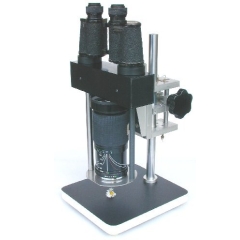
DIY Stereo-Zoom Microscope
Posted November 16, 2012 by Chris
“This project allows you to fabricate, with your own hands, a high quality stereo-zoom microscope, an instrument very useful for observing natural samples. As a bonus, it will serve to instill in young people, as well as adults, an interest in biology.”
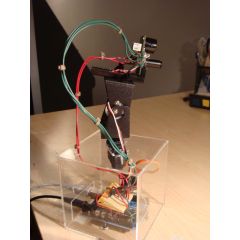
Arduino Thermal Camera
Posted November 13, 2012 by Chris
“The device works by sweeping a grid of points and assembles the image piecewise. The output consists of two images: [1] an acoustic images which tells the distance to the objects in view and [2] a thermal image that gives the temperature of the objects in view. I use gnuplot to assemble the images.”
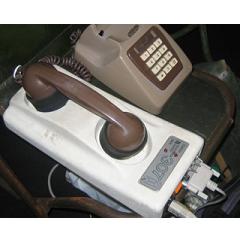
Acoustic Data Acquisition with Mathematica
Posted October 30, 2012 by Chris
“Just about any physical signal or measurement in the world can be converted into a fluctuating voltage, an analog signal. Most laptops have a built-in microphone, so if you can convert your voltage into an audible signal, you can use the microphone to digitize it. Once it is in digital form, you can then process the signal with any programming language. Here we’ll use Mathematica.”


Air Jam: Wearable Air Guitar
Posted October 6, 2012 by Chris
“Why a working, wearable air guitar? Bottom line, it’s just that cool. Who doesn’t want a machine that will take their jamming and turn it into rock they can hear? With just a glove, a pick and a little practice you can rock the synthetic acoustic guitar like no one else in the world.”

Flex Sensor with Arduino
Posted October 3, 2012 by Chris
“In this tutorial, we will use the Arduino to read a flex sensor. The flex sensor is a device that changes its resistance proportional to its form, stretched or relaxed.”
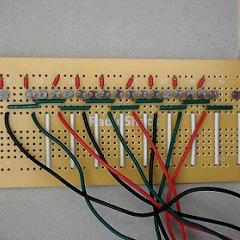
Buildling An Optical Flow Sensor (Arduino + CdS + Shoebox)
Posted September 29, 2012 by Chris
“This device is no match for an Randy’s sensor, but it does (minimally) work. Think of this little project as a fun hack more than anything else. But with some tweaking and size reduction someone could probably implement an occasionally working altitude hold sensor for a fixed-wing RC aircraft.”

Plant watering Alarm
Posted September 24, 2012 by Chris
“Well, living together with a person comes with some responsibilities that are to be tackled. Like watering plants. My friend I’m sharing an apartment with was leaving for a couple of weeks and has burdened me with a task to take care of several pots with alien life forms.”

Using the BlackBerry PlayBook for Rapid Prototyping
Posted September 19, 2012 by Chris
“With the relative complexity of today’s electronics, it’s not feasible to start from scratch; you need good building blocks to implement your vision. You’ll want to use commercial off- the-shelf components as much as possible and you most likely don’t want to be bound to a bulky PC…So how do we get started prototyping our ideas with the BlackBerry PlayBook tablet? For electronics concepts: enter Arduino.”

Gesture MIDI Interface (PIC)
Posted August 28, 2012 by Chris
“Imagine this: you have your headphones on. When you turn your hand to the right there are the dark and low sounds. Turn your hand to the left and you hear bright shining bells. The other hand lets you shift the sound left or right as you like or just make more space as you turn forward. You can slowly turn from one side to the other, from dark to bright, from closed to wide, and the sound in your head follows your motion.”
Currently Hot

An Arduino Outputting VGA Signals
output some basic vga using an arduino uno

Super Simple Arduino Tachometer
build an arduino tachometer and measure rpms

Arduino 16×2 LCD Interface
display characters on an lcd using your arduino

DE0-Nano FPGA Tilt Sensing
use the de0-nano board to sense tilt and acceleration
DE0-Nano FPGA Breakout Board
build your own custom i/o expander breakout board
Animatronics

Recent Articles

Arduino DDS Shield
build your own arduino based analog signal generator

A Digital Multimeter In Review (Tenma 72-7735)
learn about your typical digital multimeter in review

The PIC Annoy PCB
build something to annoy your co-workers

Automate Your Life With Cron
learn how to use cron for computer automation

Web Scraping For Weather Updates
learn how to use php to scrape the web

Creating A Web Server In Linux
learn how to make a lamp web server in linux

Stepper Motor Control With A stepRocker TMCM-1110
learn how a commercial stepper motor controller works

Arduino To PIC Wireless Proximity Motor Control
control a motor with a distance sensor wirelessly

PIC to Arduino Wireless Communication via XBee
use xbee to make a pic wirelessly talk to an arduino

Motor Control via Infrared Distance Sensor
control a motor simply by waving your hand

