



Get started learning to build your own electronics by following our FREE online courses below!
Learn More »
Categories
- animatronics (12)
- apple (11)
- arduino (179)
- art (41)
- articles (121)
- artificial intelligence (11)
- automation (421)
- avr (205)
- bitcoin (3)
- breadboard (9)
- cameras (57)
- cars (26)
- cell phones (28)
- clothing mods (21)
- console mods (26)
- dangerous (94)
- desktop mods (24)
- embedded (5)
- flying things (54)
- fpga (22)
- gaming creations (108)
- interface (225)
- internet (17)
- laptop mods (6)
- lasers (22)
- linux (7)
- magnetic (3)
- medical (12)
- microcontrollers (51)
- misc projects (152)
- msp (12)
- music (124)
- pic (90)
- projects (23)
- pyroedu (76)
- raspberry pi (26)
- robots (312)
- security (36)
- sensors (307)
- software (200)
- solar (19)
- stamp (9)
- tools (149)
- tutorials (98)
- Uncategorized (45)
- usb (44)
- wireless (256)
Sponsors
Build Like A Pyro!
Find many of the parts used on this site at our favorite online electronics shop


Mini DDS (Direct Digital Synthesis)
Posted June 18, 2012 by Chris
“I often need a simple function generator. Just to generate a certain frequency. After all the years I’ve worked with electronics, I still haven’t got me one. Even though I need it now and then, I just couldn’t seem to justify the cost of one. So, standard solution – build one yourself.”
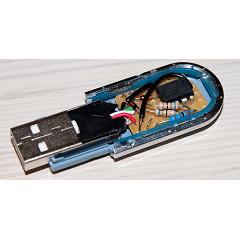
DIY USB Password Generator
Posted May 18, 2012 by Chris
“As USB keyboards were an area untouched, I decided to make a small USB HID keyboard device that types a password stored in EEPROM every time it’s attached. A new password can be generated just by tabbing CAPS LOCK a few times.”

Microcontroller Prime Number Calculator
Posted May 1, 2012 by Chris
“Although I’m planning on improving the software (better menus, the addition of sound, and implementation of a more efficient algorithm) and hardware, this device is currently functional therefore theoretically complete. This entry will serve as the primary reference page for the project, so I will provide a brief description of what it is and what it does.”

LED Dog Collar
Posted April 28, 2012 by Chris
“So the collar runs off an Atmel AVR ATTINY2313. It has 5 blue LEDs, and is powered by 3 AAA batteries. I also etched a custom circuit board (toner transfer method) and then covered most of the components in hot glue. The LEDs and all the wires on the collar are also mounted using hot glue.”

Making a USB Based AVR Programmer
Posted April 22, 2012 by Chris
“Around time when I was beginning to learn about microcontrollers I had exchanged my laptop with a senior at college for his desktop – that’s because the only way I knew how to program an ATMEGA chip was through either a serial port or a parallel port…Over the time I learned about an inexpensive way of making a USB based AVR programmer called USBasp. It’s faster, cheaper and has the convenience of letting you program AVRs from laptops. ”
Currently Hot

Programming the eBOX
create & download an os image to the eBOX-II

The Altera DE2 Board
a simple introduction for setting up the DE2 board
The eBOX-II Embedded PC
learn the in's and out's of the eBOX-II

Stepper Motor Control
control a stepper motor using an LMD18245

PIC Prototyping Basics
build your own pic prototype development board
Animatronics

Recent Articles

Arduino DDS Shield
build your own arduino based analog signal generator

A Digital Multimeter In Review (Tenma 72-7735)
learn about your typical digital multimeter in review

The PIC Annoy PCB
build something to annoy your co-workers

Automate Your Life With Cron
learn how to use cron for computer automation

Web Scraping For Weather Updates
learn how to use php to scrape the web

Creating A Web Server In Linux
learn how to make a lamp web server in linux

Stepper Motor Control With A stepRocker TMCM-1110
learn how a commercial stepper motor controller works

Arduino To PIC Wireless Proximity Motor Control
control a motor with a distance sensor wirelessly

PIC to Arduino Wireless Communication via XBee
use xbee to make a pic wirelessly talk to an arduino

Motor Control via Infrared Distance Sensor
control a motor simply by waving your hand

