



Get started learning to build your own electronics by following our FREE online courses below!
Learn More »
Categories
- animatronics (12)
- apple (11)
- arduino (179)
- art (41)
- articles (121)
- artificial intelligence (11)
- automation (421)
- avr (205)
- bitcoin (3)
- breadboard (9)
- cameras (57)
- cars (26)
- cell phones (28)
- clothing mods (21)
- console mods (26)
- dangerous (94)
- desktop mods (24)
- embedded (5)
- flying things (54)
- fpga (22)
- gaming creations (108)
- interface (225)
- internet (17)
- laptop mods (6)
- lasers (22)
- linux (7)
- magnetic (3)
- medical (12)
- microcontrollers (51)
- misc projects (152)
- msp (12)
- music (124)
- pic (90)
- projects (23)
- pyroedu (76)
- raspberry pi (26)
- robots (312)
- security (36)
- sensors (307)
- software (200)
- solar (19)
- stamp (9)
- tools (149)
- tutorials (98)
- Uncategorized (45)
- usb (44)
- wireless (256)
Sponsors
Build Like A Pyro!
Find many of the parts used on this site at our favorite online electronics shop


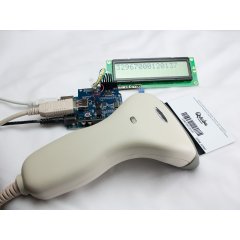
Connecting A Barcode Scanner To An Arduino
Posted February 25, 2013 by Chris
“A gadget that I demonstrate today is a portable autonomous barcode scanner built using an Arduino board, USB Host shield, handheld USB barcode scanner and LCD display. The operation is simple – when handheld scanner button is pressed, it scans the barcode and sends it to the Arduino symbol by symbol. The Arduino then outputs these symbols on LCD display.”
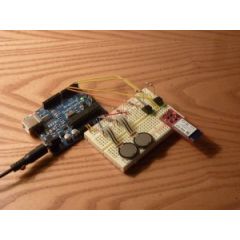
Instrumented Steering Wheel Project Demo
Posted February 24, 2013 by Chris
“This project seeks to develop an additional form of authentication for vehicle security, specifically in the form of a tapped password. The goal of this project is to implement this form of authentication and determine the level of possible security while maintaining enough flexibility to allow human variation in password inputs.”

Bluetooth Wireless Bathroom Scale
Posted February 23, 2013 by Chris
“Start with a cheap bathroom scale from ikea, then strip out all the hardware except for the load cells. Add in the following: a microcontroller, roving networks bluetooth serial module, 24 bit ADC, 4 AA batteries, a linear regulator and input ORing diodes.”

RSS Reader Using AVR Mega8
Posted February 22, 2013 by Chris
“I spent part of an afternoon developing a hardware RSS reader (most of my time was spent on the python side of things). It’s pretty simple and uses an AVR microcontroller connected to a computer via a serial cable.”
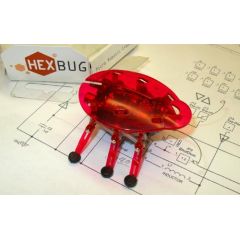
Hexbug Hack – Give your Hexbug a Real Brain!
Posted February 20, 2013 by Chris
“Now the real fun begins. Even though the Hexbug’s motion is limited, with the addition of a few simple sensors and some clever programming, it can do remarkable things. For example, a right turn is accomplished by doing a reverse turn for about 2 seconds. How can it make a left turn? Simply do a right turn for 6 seconds – 3 right turns equal one left turn.”

DIY dsPIC Breadboard
Posted February 19, 2013 by Chris
“This thing may remind you of an Arduino but it’s not, it’s not even an AVR but a dsPIC30F2012. Lots of times I want to try out something, but I’m too lazy to make the whole thing over and over on a breadboard so why not solder it together quick on a pref board so I can just stick it in. And always too lazy to put on RS232, but it’s a great debug so that’s why it’s on the board, actually it’s the only feature that’s built in to the board, because its really the only thing I need.”
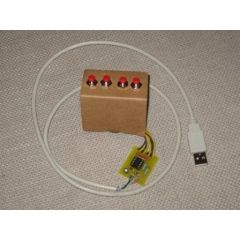
4 Key Keyboard
Posted February 18, 2013 by Chris
“Only recently I’ve found the time to expand my old project in the most obvious way possible; by adding 3 more buttons to these IO ports and thereby creating a 4-key-keyboard, without having to add any other hardware than these 3 extra buttons.”

Stand-alone PIC-based Programmable LED
Posted February 17, 2013 by Chris
“Alex Weber over at Instructables built a great programmable LED based on the AVR chip. Since I am tooled for PIC, I thought it would be fun to replicate what he has done. This simple project is fun and it provides a great building block for playing with collective behaviors.”
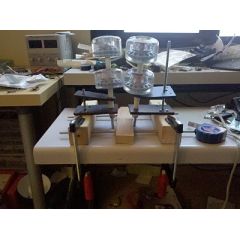
Forearm Massager For Climbers (and Keyboarders)
Posted February 16, 2013 by Chris
“In the quest to relieve perpetually tense forearms due to bouldering + heavy keyboard usage I came up with this massager using easily obtained components. The total parts list with estimated price: (all items except for skateboard wheels were obtained at Lowe’s).”

Virtual Oscilloscope (Shockwave Simulation)
Posted February 15, 2013 by Chris
“The oscilloscope simulation shown on this website is based on the HAMEG HM203-6 20 MHz oscilloscope of Hameg GmbH in Frankfurt/Main, Germany. The HAMEG HM203-6 oscilloscope only was the inspiration for developing the simulation, because it is very well suited for this purpose.”
Currently Hot

The Stunning Camera
shock your friends when they take your picture

A Simple File Server
make a file server on your pc

A Simple VHDL Counter
create a simple counter using vhdl with a cpld

An Introduction To VHDL
a small tutorial on using vhdl with a cpld

The Autonomous Drifter
autonomous drifter controlled by your laptop
Animatronics

Recent Articles

Arduino DDS Shield
build your own arduino based analog signal generator

A Digital Multimeter In Review (Tenma 72-7735)
learn about your typical digital multimeter in review

The PIC Annoy PCB
build something to annoy your co-workers

Automate Your Life With Cron
learn how to use cron for computer automation

Web Scraping For Weather Updates
learn how to use php to scrape the web

Creating A Web Server In Linux
learn how to make a lamp web server in linux

Stepper Motor Control With A stepRocker TMCM-1110
learn how a commercial stepper motor controller works

Arduino To PIC Wireless Proximity Motor Control
control a motor with a distance sensor wirelessly

PIC to Arduino Wireless Communication via XBee
use xbee to make a pic wirelessly talk to an arduino

Motor Control via Infrared Distance Sensor
control a motor simply by waving your hand

