



Get started learning to build your own electronics by following our FREE online courses below!
Learn More »
Categories
- animatronics (12)
- apple (11)
- arduino (179)
- art (41)
- articles (121)
- artificial intelligence (11)
- automation (421)
- avr (205)
- bitcoin (3)
- breadboard (9)
- cameras (57)
- cars (26)
- cell phones (28)
- clothing mods (21)
- console mods (26)
- dangerous (94)
- desktop mods (24)
- embedded (5)
- flying things (54)
- fpga (22)
- gaming creations (108)
- interface (225)
- internet (17)
- laptop mods (6)
- lasers (22)
- linux (7)
- magnetic (3)
- medical (12)
- microcontrollers (51)
- misc projects (152)
- msp (12)
- music (124)
- pic (90)
- projects (23)
- pyroedu (76)
- raspberry pi (26)
- robots (312)
- security (36)
- sensors (307)
- software (200)
- solar (19)
- stamp (9)
- tools (149)
- tutorials (98)
- Uncategorized (45)
- usb (44)
- wireless (256)
Sponsors
Build Like A Pyro!
Find many of the parts used on this site at our favorite online electronics shop


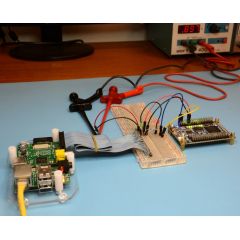
Raspberry Pi + DE0-Nano FPGA = BitCoin Miner
Posted February 17, 2014 by Chris
"In the mining rig described here an FPGA does all the hard work (SHA-256 hashing) and communicates over a serial link with a Raspberry Pi. The latter requesting new work from, and submitting proof of work done to, a Bitcoin mining pool."
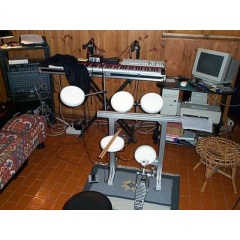
MIDI Drum Electronic Circuit
Posted February 15, 2014 by Chris
"This circuit is a MIDI interface between drum pads and computer or hardware sequencer. Using this circuit you can hit pads with drumsticks and store the MIDI data in real time."
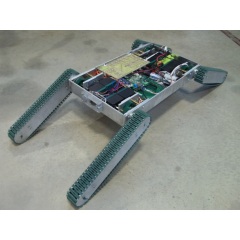
Team 8 – Rescue Robot For Extraction
Posted February 14, 2014 by Chris
"The purpose of the prototype was to demonstrate the feasibility of a small, highly maneuverable search and rescue robot. As such, the completed prototype was successful. Capabilities include a ground speed of 10 inches per second, battery life of 50 minutes, wireless range of between 50 and 150 feet, weight of 14.5 pounds and the ability to climb stairs."

Remote Controlling a Car over the Web
Posted February 13, 2014 by Chris
"In just a few hours of hacking and experimenting, we turned this radio-controlled car into a WebSocket-controlled car. Don’t worry, no actual cars (or bunnies) were harmed in the making of this demo, as you’ll see as we walk through the hardware and software we used."
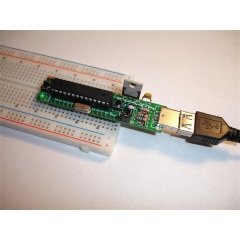
USnooBie (Open Source AVR USB Device Development Kit)
Posted February 12, 2014 by Chris
"The USnooBie is a microcontroller kit that does not require any sort of AVR programmer or USB-to-serial converters to load and run compiled code. It’s hardware design allows the user to develop low cost USB devices with Atmel’s AVR ATmega microcontrollers. It can also be used to develop projects which are not USB devices. It is even compatible with Arduino."

TV Demonstrator for TI calculators
Posted February 11, 2014 by Chris
"This easy-to-build electronic device allows you to take a screenshot of your calculator display and show it on an NTSC or PAL television set. Unlike the TI-Presenter this does not require a special calculator or a USB adaptor; it uses the 2.5mm link port."
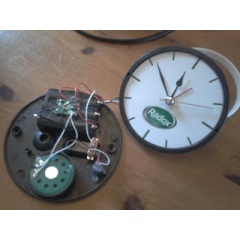
Alarm Clock Project – Playing WAV Files With A PIC Microcontroller
Posted February 10, 2014 by Chris
"An interesting project has come up as a fund-raiser for BuildBrighton members – to ‘hack’ some alarm clocks and modify their behavior so that instead of playing a single sample when the alarm sounds, one of up to seven different sounds can be played."
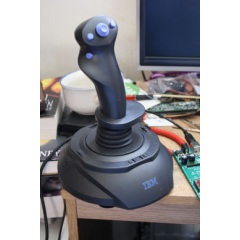
PIC Joystick USB Interface
Posted February 9, 2014 by Chris
"With the phasing out of game, serial and parallel ports from modern computers and the ever increasing popularity of USB, it makes sense that hobbyists start getting to grips working with USB….This project focuses on the use of a USB PIC and the mikroC compiler to convert an old game port joystick to utilize USB."
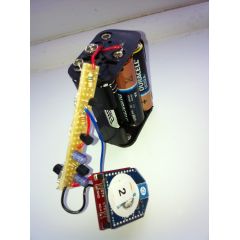
YAHMS: Temperature Probes
Posted February 8, 2014 by Chris
"My wireless temperature probes work by using an Xbee module to transmit readings from a TMP36 down to the Arduino base station…these take a voltage of around 3-5.5V as input and will output a voltage between 0-2.7V to indicate the temperature, which can be from -40 – 125°C."
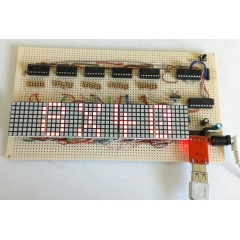
8×40 LED matrix marquee using shift registers
Posted February 7, 2014 by Chris
"The heart of this project is PIC16F1847 microcontroller which receives data from a PC through a serial port, and display on the LED matrix with the help of five 74HC595 shift registers."
Currently Hot

How To Build An 8x8x8 LED Cube
build an 8x8x8 led cube to mezmorize your friends

Simple RF Receiver And Transmitter @ 27 MHz
build a simple 27 mhz receiver module

Simple 27 MHz RF Transmitter
build a simple rf transmitter with very few parts

Multi Servo Control Using Arduino UNO
control many servos at once using arduino uno

Fading LED Heart Birthday Present
an led heart as a simple birthday present
Animatronics

Recent Articles

Arduino DDS Shield
build your own arduino based analog signal generator

A Digital Multimeter In Review (Tenma 72-7735)
learn about your typical digital multimeter in review

The PIC Annoy PCB
build something to annoy your co-workers

Automate Your Life With Cron
learn how to use cron for computer automation

Web Scraping For Weather Updates
learn how to use php to scrape the web

Creating A Web Server In Linux
learn how to make a lamp web server in linux

Stepper Motor Control With A stepRocker TMCM-1110
learn how a commercial stepper motor controller works

Arduino To PIC Wireless Proximity Motor Control
control a motor with a distance sensor wirelessly

PIC to Arduino Wireless Communication via XBee
use xbee to make a pic wirelessly talk to an arduino

Motor Control via Infrared Distance Sensor
control a motor simply by waving your hand

