



Get started learning to build your own electronics by following our FREE online courses below!
Learn More »
Categories
- animatronics (12)
- apple (11)
- arduino (179)
- art (41)
- articles (121)
- artificial intelligence (11)
- automation (421)
- avr (205)
- bitcoin (3)
- breadboard (9)
- cameras (57)
- cars (26)
- cell phones (28)
- clothing mods (21)
- console mods (26)
- dangerous (94)
- desktop mods (24)
- embedded (5)
- flying things (54)
- fpga (22)
- gaming creations (108)
- interface (225)
- internet (17)
- laptop mods (6)
- lasers (22)
- linux (7)
- magnetic (3)
- medical (12)
- microcontrollers (51)
- misc projects (152)
- msp (12)
- music (124)
- pic (90)
- projects (23)
- pyroedu (76)
- raspberry pi (26)
- robots (312)
- security (36)
- sensors (307)
- software (200)
- solar (19)
- stamp (9)
- tools (149)
- tutorials (98)
- Uncategorized (45)
- usb (44)
- wireless (256)
Sponsors
Build Like A Pyro!
Find many of the parts used on this site at our favorite online electronics shop


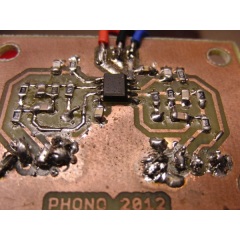
Phono Preamp Electronics Project
Posted March 25, 2014 by Chris
"Mr. Hat contacted me asking for a help in building a phono preamp for his vinyl record player that he recovered from oblivion somewhere. As you probably know, there are some issues with vinyl records that require audio tracks to be mastered in certain way before they are put into a disc."

DIY 8051 Network Cable Tester
Posted March 24, 2014 by Chris
"Designed and built during October 2000, this was my first ever microcontroller based project. This one was inspired by an Edmund Scientific instruments catalog. I didn’t see anything like this in that catalog but there were a lot of nice, year 2000 modern multipole cable testers, that made me think and imagine what would be the simplest possible network cable tester that I could quickly build."
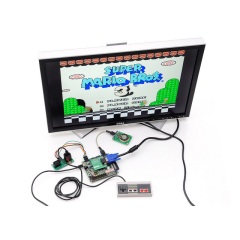
FPGA NES Using Xilinx Spartan3
Posted March 23, 2014 by Chris
"Behold: a complete Nintendo Entertainment System cloned in an FPGA! Originally written in VHDL by Brent Allen and myself while at Washington State University, I’ve recently revisited this project and begun both: rewriting it in Verilog, and adding many new features."

DIY Xilinx Parallel Cable III
Posted March 22, 2014 by Chris
"This is a simple JTAG interface, which can be connected to computer’s parallel port. It is originally designed by Xilinx to program FPGAs and CPLDs… It is a one-sided PCB, the bottom side is made from wires."
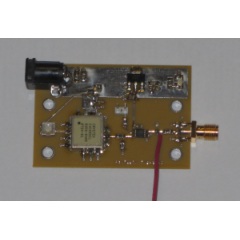
Garage Door Hack
Posted March 21, 2014 by Chris
"One field of communication and DSP that has always intrigued me is signal intelligence, the attempt to receive and decode an unknown signal. It’s an interesting puzzle that requires a wide variety of hardware, software, and analytical skills…I decided I would try to receive and decode the signal my garage door remote transmits to the base unit to open and close the door."

Microcontrollers: A Hardware Hello World
Posted March 20, 2014 by Chris
Are you ready to say Hello World? Today we’re releasing the second lesson in our new course: An Introduction To Microcontrollers is live. Here’s an overview of the lesson:
"Building a ‘hello world’ application signifies a time honored approach to learning how to program. In this lesson, we will explore the first steps necessary for building and loading programs onto a microcontroller."

DIY Pick and Place V2 Project
Posted March 19, 2014 by Chris
"The DIY pick and place machine project is now finally running and is able to place the components for our Raspberry Pi expansion boards. This project started in July 2013 when we began to order the various components, bearings, motors, drive systems, frame materials etc and we started to build the machine in September."

Open Automation Project
Posted March 18, 2014 by Chris
"The objective is to use readily available ‘off-the-shelf’ low-cost consumer components where possible, and to design electronic subsystems where such components are either not readily available or are too expensive. In terms of affordability, the overall goal is to design a robot that can be made for around the price of a PC."

LED Flower (PWM-controlled RGB LEDs)
Posted March 17, 2014 by Chris
"LED Flowers are a set of PWM-controlled RGB LEDs which get their settings via USB using obdev.at’s USB stack. Everything needed for this workshop is under a free license, so feel free to copy and modify."
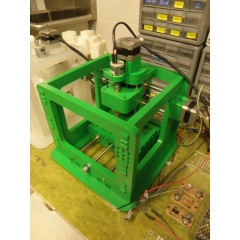
MTM Snap: A Snap-Together CNC milling machine
Posted March 16, 2014 by Chris
"Jonathan Ward from the MIT Center for Bits and Atoms has designed a snap-together, desktop-sized CNC milling machine. The MTM Snap is made from 1/2-inch high-density polyethylene (HDPE) – itself milled on a ShopBot – and can be assembled for about $700. This three-axis CNC machine can mill circuit boards, wax molds, and harder materials in a 5x3x1.75″ working area. "
Currently Hot

How To Build An 8x8x8 LED Cube
build an 8x8x8 led cube to mezmorize your friends

Simple RF Receiver And Transmitter @ 27 MHz
build a simple 27 mhz receiver module

Simple 27 MHz RF Transmitter
build a simple rf transmitter with very few parts

Multi Servo Control Using Arduino UNO
control many servos at once using arduino uno

Fading LED Heart Birthday Present
an led heart as a simple birthday present
Animatronics

Recent Articles

Arduino DDS Shield
build your own arduino based analog signal generator

A Digital Multimeter In Review (Tenma 72-7735)
learn about your typical digital multimeter in review

The PIC Annoy PCB
build something to annoy your co-workers

Automate Your Life With Cron
learn how to use cron for computer automation

Web Scraping For Weather Updates
learn how to use php to scrape the web

Creating A Web Server In Linux
learn how to make a lamp web server in linux

Stepper Motor Control With A stepRocker TMCM-1110
learn how a commercial stepper motor controller works

Arduino To PIC Wireless Proximity Motor Control
control a motor with a distance sensor wirelessly

PIC to Arduino Wireless Communication via XBee
use xbee to make a pic wirelessly talk to an arduino

Motor Control via Infrared Distance Sensor
control a motor simply by waving your hand

