



Get started learning to build your own electronics by following our FREE online courses below!
Learn More »
Categories
- animatronics (12)
- apple (11)
- arduino (179)
- art (41)
- articles (121)
- artificial intelligence (11)
- automation (421)
- avr (205)
- bitcoin (3)
- breadboard (9)
- cameras (57)
- cars (26)
- cell phones (28)
- clothing mods (21)
- console mods (26)
- dangerous (94)
- desktop mods (24)
- embedded (5)
- flying things (54)
- fpga (22)
- gaming creations (108)
- interface (225)
- internet (17)
- laptop mods (6)
- lasers (22)
- linux (7)
- magnetic (3)
- medical (12)
- microcontrollers (51)
- misc projects (152)
- msp (12)
- music (124)
- pic (90)
- projects (23)
- pyroedu (76)
- raspberry pi (26)
- robots (312)
- security (36)
- sensors (307)
- software (200)
- solar (19)
- stamp (9)
- tools (149)
- tutorials (98)
- Uncategorized (45)
- usb (44)
- wireless (256)
Sponsors
Build Like A Pyro!
Find many of the parts used on this site at our favorite online electronics shop


GHWT And Rock Band MIDI Filter for Drums
Posted July 27, 2012 by Chris
“Mildly unsatisfied with my earlier, more obvious solution for using an electronic drum kit to play Guitar Hero World Tour (that is, just changing a few MIDI note settings), I’ve put together a solution I like better – a microcontroller which filters the MIDI signal between the drum kit sound module and the GHWT controller.”

LED Fading via CPLD PWM
Posted July 26, 2012 by Chris
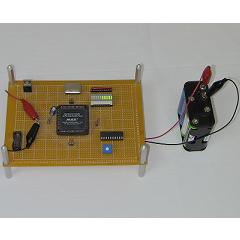
“This article will use the same theory from the microcontroller version of fading LEDs but we’ll use the CPLD Dev Board seen last in the connected ADCs to FPGAs article. There we connected up a 10 LED Bar which we will use in this article to show how to create that fading-in and fading-out effect via PWM.”

An Electronic Keyboard Using An Integrated Circuit
Posted July 25, 2012 by Chris
“This project has three parts. The circuit board is made in Part I. Part II involves building the base for the keyboard. The base is a wooden platform that contains the ‘keys’ or switches that activate various tones, and provides a mounting surface for the circuit board, speaker, and battery. In Part III circuit board is attached to the base and the keyboard is assembled and tested.”
RF Radiation And Cell Phone Detector
Posted July 24, 2012 by Chris
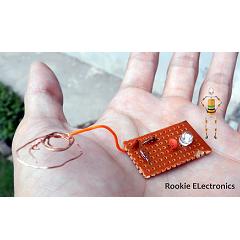
“This is my favourite project, its too simple and very interesting because it does not require any voltage source 😀 it converts RF frequency waves from cell phone (whenever you call or send a text) to little current to flash a LED.”

Arduino LED Cylinder
Posted July 23, 2012 by Chris
“This is a little art project I made with 95 RGB LEDs arranged in a 3D cylinder shape, sitting atop a microcontroller-based driver circuit. The LEDs are individually addressable, and when you power it on, the software cycles through a series of animations, e.g. various moving rainbowy patterns, ‘rain’, ‘fireworks’, and so on. It doesn’t serve much of a purpose but it is kind of cool to look at.”
Game of Life – RadikalDesig
Posted July 22, 2012 by Chris
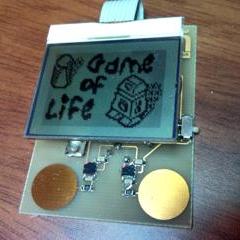
“It’s been too much time without writing here and I have many ideas but little time to get them built and documented. This time I’ll do a typical programming exercise, the ‘Game of Life’ by John Horton Conway.”

Geeky LED Advent Wreath
Posted July 21, 2012 by Chris
“The idea came to me after seeing Sprite’s minimalistic version of the Hackaday’s Flickering LED circuit. It’s a simple circuit that flickers LEDs and detects darkness. I thought that this could make a great little Advent wreath. My version should have 4 LEDs and should be support first, second, third and fourth Advent.”

Building Some Infrared Sensor Modules
Posted July 20, 2012 by Chris
“In this tutorial we will see how to make simple infrared sensor module for detecting reflecting surface. This sensor can be used to detect reflecting silver/white strip, obstacle detection, flame detection, etc. These sensors are primary requirement of any simple line follower robo-car.”
AVR Nikon Camera Remote Control
Posted July 19, 2012 by Chris
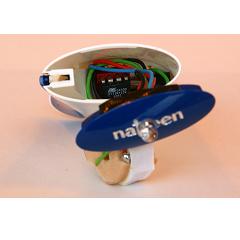
“This is an IR remote control for Nikon cameras. It is compatible with the Nikon ML-L3 remote control…The circuit is extremely simple: an ATtiny13V, button, transistor, resistor, IR diode and 3V battery. You could even omit the transistor and resistor, and connect the IR diode directly to the ATtiny13V, but that will limit the LED current and therefor the range.”
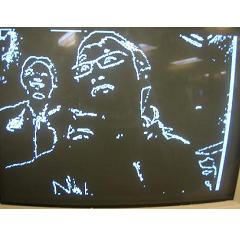
Real-Time FPGA Edge Detection
Posted July 18, 2012 by Chris
“For our ECE536 final project, we have implemented real-time sobel edge detection. Traditionally, sobel edge detection is done on still images. This project uses a 2MP camera to continuously capture an image stream, and sobel edge detection is performed real-time on an FPGA and displayed to a VGA monitor. Our motivation arose from our interest in computer vision and digital image processing.”
Currently Hot

Web Scraping For Weather Updates
learn how to use php to scrape the web

Creating A Web Server In Linux
learn how to make a lamp web server in linux

Stepper Motor Control With A stepRocker TMCM-1110
learn how a commercial stepper motor controller works

Arduino To PIC Wireless Proximity Motor Control
control a motor with a distance sensor wirelessly

PIC to Arduino Wireless Communication via XBee
use xbee to make a pic wirelessly talk to an arduino
Animatronics

Recent Articles

Arduino DDS Shield
build your own arduino based analog signal generator

A Digital Multimeter In Review (Tenma 72-7735)
learn about your typical digital multimeter in review

The PIC Annoy PCB
build something to annoy your co-workers

Automate Your Life With Cron
learn how to use cron for computer automation
Web Scraping For Weather Updates
learn how to use php to scrape the web
Creating A Web Server In Linux
learn how to make a lamp web server in linux
Stepper Motor Control With A stepRocker TMCM-1110
learn how a commercial stepper motor controller works
Arduino To PIC Wireless Proximity Motor Control
control a motor with a distance sensor wirelessly
PIC to Arduino Wireless Communication via XBee
use xbee to make a pic wirelessly talk to an arduino

Motor Control via Infrared Distance Sensor
control a motor simply by waving your hand

