



Get started learning to build your own electronics by following our FREE online courses below!
Learn More »
Categories
- animatronics (12)
- apple (11)
- arduino (179)
- art (41)
- articles (121)
- artificial intelligence (11)
- automation (421)
- avr (205)
- bitcoin (3)
- breadboard (9)
- cameras (57)
- cars (26)
- cell phones (28)
- clothing mods (21)
- console mods (26)
- dangerous (94)
- desktop mods (24)
- embedded (5)
- flying things (54)
- fpga (22)
- gaming creations (108)
- interface (225)
- internet (17)
- laptop mods (6)
- lasers (22)
- linux (7)
- magnetic (3)
- medical (12)
- microcontrollers (51)
- misc projects (152)
- msp (12)
- music (124)
- pic (90)
- projects (23)
- pyroedu (76)
- raspberry pi (26)
- robots (312)
- security (36)
- sensors (307)
- software (200)
- solar (19)
- stamp (9)
- tools (149)
- tutorials (98)
- Uncategorized (45)
- usb (44)
- wireless (256)
Sponsors
Build Like A Pyro!
Find many of the parts used on this site at our favorite online electronics shop



Microcontrollers: A Hardware Hello World
Posted March 20, 2014 by Chris
Are you ready to say Hello World? Today we’re releasing the second lesson in our new course: An Introduction To Microcontrollers is live. Here’s an overview of the lesson:
"Building a ‘hello world’ application signifies a time honored approach to learning how to program. In this lesson, we will explore the first steps necessary for building and loading programs onto a microcontroller."


DIY Pick and Place V2 Project
Posted March 19, 2014 by Chris
"The DIY pick and place machine project is now finally running and is able to place the components for our Raspberry Pi expansion boards. This project started in July 2013 when we began to order the various components, bearings, motors, drive systems, frame materials etc and we started to build the machine in September."

Open Automation Project
Posted March 18, 2014 by Chris
"The objective is to use readily available ‘off-the-shelf’ low-cost consumer components where possible, and to design electronic subsystems where such components are either not readily available or are too expensive. In terms of affordability, the overall goal is to design a robot that can be made for around the price of a PC."

LED Flower (PWM-controlled RGB LEDs)
Posted March 17, 2014 by Chris
"LED Flowers are a set of PWM-controlled RGB LEDs which get their settings via USB using obdev.at’s USB stack. Everything needed for this workshop is under a free license, so feel free to copy and modify."
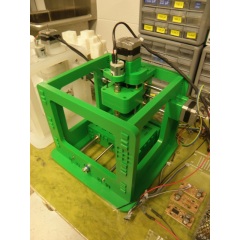
MTM Snap: A Snap-Together CNC milling machine
Posted March 16, 2014 by Chris
"Jonathan Ward from the MIT Center for Bits and Atoms has designed a snap-together, desktop-sized CNC milling machine. The MTM Snap is made from 1/2-inch high-density polyethylene (HDPE) – itself milled on a ShopBot – and can be assembled for about $700. This three-axis CNC machine can mill circuit boards, wax molds, and harder materials in a 5x3x1.75″ working area. "

Mister Gloves – A Wireless USB Gesture Input System
Posted March 15, 2014 by Chris
"Mister Gloves is a wireless USB gesture input system that enables a person to use a computer by performing intuitive hand and finger motions in the air. While wearing a glove controller on the right hand, the user can move the cursor by forming a pointing gesture and click by curling the index finger or thumb."
Intro to Microcontrollers: Lesson 1 Live!
Posted March 13, 2014 by Chris
Today we’re happy to announce that lesson 1 of our new course: An Introduction To Microcontrollers is live. Here’s an overview of the lesson:
"Want to learn about microcontrollers? Please start here! This lesson explains the course content, what expectations you should have and what parts are needed for the course."

Stripboard PID Arduino Shield
Posted March 12, 2014 by Chris
"A PID controller is like a kind of fancy thermostat, but can be used to control pretty much any kind of process, not just heating and cooling. This project was inspired by the osPID and its design is greatly indebted to that pioneering device."

The Magic Crystal Mood Ball
Posted March 11, 2014 by Chris
"The mood that the ‘Magic Crystal Mood Ball’ gives to the user is based on measuring his temperature and changing the color of the RGB LED to the its respective color. As in a mood ring, I set different colors for different temperatures. The temperatures coincides with mood state that the person is in."

Driving 75_595 Shift Registers With AVR Hardware SPI
Posted March 10, 2014 by Chris
"Driving a shift register using an AVR chip’s built-in hardware is really quite easy. Most of their offerings have an SPI module, or Serial Peripheral Interface. A shift register is exactly that, a peripheral device that communicates via a serial line. All we need to do is hook up our connections and use a few pieces of simple code. Join me after the break to see how that’s done."
Currently Hot

Programming the eBOX
create & download an os image to the eBOX-II

The Altera DE2 Board
a simple introduction for setting up the DE2 board
The eBOX-II Embedded PC
learn the in's and out's of the eBOX-II

Stepper Motor Control
control a stepper motor using an LMD18245

PIC Prototyping Basics
build your own pic prototype development board
Animatronics

Recent Articles

Arduino DDS Shield
build your own arduino based analog signal generator

A Digital Multimeter In Review (Tenma 72-7735)
learn about your typical digital multimeter in review

The PIC Annoy PCB
build something to annoy your co-workers

Automate Your Life With Cron
learn how to use cron for computer automation

Web Scraping For Weather Updates
learn how to use php to scrape the web

Creating A Web Server In Linux
learn how to make a lamp web server in linux

Stepper Motor Control With A stepRocker TMCM-1110
learn how a commercial stepper motor controller works

Arduino To PIC Wireless Proximity Motor Control
control a motor with a distance sensor wirelessly

PIC to Arduino Wireless Communication via XBee
use xbee to make a pic wirelessly talk to an arduino

Motor Control via Infrared Distance Sensor
control a motor simply by waving your hand

