



Get started learning to build your own electronics by following our FREE online courses below!
Learn More »
Categories
- animatronics (12)
- apple (11)
- arduino (179)
- art (41)
- articles (121)
- artificial intelligence (11)
- automation (421)
- avr (205)
- bitcoin (3)
- breadboard (9)
- cameras (57)
- cars (26)
- cell phones (28)
- clothing mods (21)
- console mods (26)
- dangerous (94)
- desktop mods (24)
- embedded (5)
- flying things (54)
- fpga (22)
- gaming creations (108)
- interface (225)
- internet (17)
- laptop mods (6)
- lasers (22)
- linux (7)
- magnetic (3)
- medical (12)
- microcontrollers (51)
- misc projects (152)
- msp (12)
- music (124)
- pic (90)
- projects (23)
- pyroedu (76)
- raspberry pi (26)
- robots (312)
- security (36)
- sensors (307)
- software (200)
- solar (19)
- stamp (9)
- tools (149)
- tutorials (98)
- Uncategorized (45)
- usb (44)
- wireless (256)
Sponsors
Build Like A Pyro!
Find many of the parts used on this site at our favorite online electronics shop


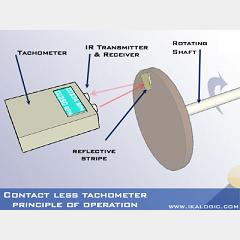
99k RPM Digital Tachometer
Posted June 21, 2011 by Chris
This article is fairly similar to my own Digital Tach except it goes a bit above and beyond. The 99k Digital Tech uses an Atmega microcontroller and amplifying hardware to get clean counter signals back from a wireless tachmeter. The article explains the details indepth with schematics and project pictures.
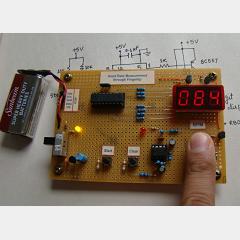
Heart Rate Measurement From Fingertip
Posted June 13, 2011 by Chris
Detecting a person’s heart rate using electronics is not as hard as it might sound. Using an infrared emitter LED, photo transistor and some knowledge about light reflectivity we can detect blood flow in a finger! Read the article for more info about how it is done and how you can build your own.
Give it a shot: Make your first robot!
Posted May 27, 2011 by Chris
Making your first robot should be a moment you remember as you progress in the electronics and robotics field. Whether it is a line follower or a wall dodger, it brings you to the first step into a larger world. Today’s article gives you a great starting point for how to build your first robot. Similar to my line follower, except with more digital circuity.

Biojoy Wristwatch Health Monitor
Posted May 24, 2011 by Chris
Even though it may not rival a wristwatch for james bond, the Biojoy wristwatch offers many cool features like measuring blood pressure or heart rate. The fairly complicated design is documented in a project pdf available for download in the article. A fun concept to look at and even funner to have something like this in DIY form.
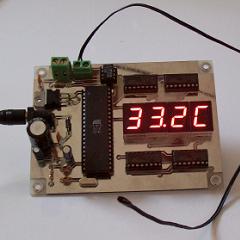
Thermistor Thermometer
Posted May 15, 2011 by Chris
For today, here’s a themometer circuit that was used as a beginning board for teaching atmel micros to students. An onboard ADC converts signals from a thermistor and an AVR displays the values on some 7-seg LEDs. The article has hardware schematics and explains the theory of the circuit.
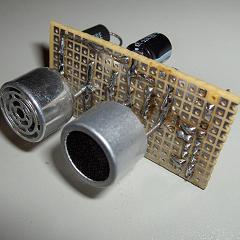
Cheap DIY Ultrasonic Sensor
Posted May 11, 2011 by Chris
Ultrasonic sensors have become very popular, however they often carry a heavy cost of $50-100. This might not be much for industry, but for hobbyists that’s a chunk of change. This article shows you how to use a PIC and 2 ultrasonic transducers to make your own sonar proximity sensor.

Foot Acceleration Sensor
Posted May 10, 2011 by Chris
Putting an accelerometer with a wireless transmitter is a quick and easy way to track foot movement. In this case, to help track why female athletes suffer more frequently from ACL injuries. The parts are all off the shelf and the article explains how it was made. A neat little project.
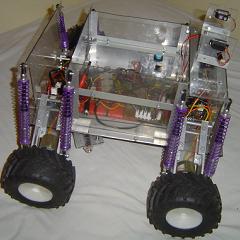
Dunk’s Mobile Robot Platform
Posted May 9, 2011 by Chris
Here is a pretty sweet little robot that is a great resource for anyone looking to build their own mobile robotics platform. The article and google project is a documentation of a robot that combines together a mobile platform with various sensors for navigation and external sensory.

An Infra-Red Link Using an AVR
Posted April 27, 2011 by Chris
The IR link design built in this article is described from start to finish, the goal being to communicate with the lego mindstorms NXT IR interface. An AVR is used with an I2C bus to communicate across the IR link. If AVR is your micro, then take a look at this well written article.

The Bilibot Project
Posted April 24, 2011 by Chris
This robotic project is an attempt to build an open source project with everyday products. The main sensor feedback comes from an Xbox Kinect, with a laptop for processing with the entire assembly ontop of a roomba-like device, making the system mobile. The project website is very transparent about how everything is being done, so no need to hunt for the details.
Currently Hot

An Arduino Outputting VGA Signals
output some basic vga using an arduino uno

Super Simple Arduino Tachometer
build an arduino tachometer and measure rpms

Arduino 16×2 LCD Interface
display characters on an lcd using your arduino

DE0-Nano FPGA Tilt Sensing
use the de0-nano board to sense tilt and acceleration
DE0-Nano FPGA Breakout Board
build your own custom i/o expander breakout board
Animatronics

Recent Articles

Arduino DDS Shield
build your own arduino based analog signal generator

A Digital Multimeter In Review (Tenma 72-7735)
learn about your typical digital multimeter in review

The PIC Annoy PCB
build something to annoy your co-workers

Automate Your Life With Cron
learn how to use cron for computer automation

Web Scraping For Weather Updates
learn how to use php to scrape the web

Creating A Web Server In Linux
learn how to make a lamp web server in linux

Stepper Motor Control With A stepRocker TMCM-1110
learn how a commercial stepper motor controller works

Arduino To PIC Wireless Proximity Motor Control
control a motor with a distance sensor wirelessly

PIC to Arduino Wireless Communication via XBee
use xbee to make a pic wirelessly talk to an arduino

Motor Control via Infrared Distance Sensor
control a motor simply by waving your hand

