



Get started learning to build your own electronics by following our FREE online courses below!
Learn More »
Categories
- animatronics (12)
- apple (11)
- arduino (179)
- art (41)
- articles (121)
- artificial intelligence (11)
- automation (421)
- avr (205)
- bitcoin (3)
- breadboard (9)
- cameras (57)
- cars (26)
- cell phones (28)
- clothing mods (21)
- console mods (26)
- dangerous (94)
- desktop mods (24)
- embedded (5)
- flying things (54)
- fpga (22)
- gaming creations (108)
- interface (225)
- internet (17)
- laptop mods (6)
- lasers (22)
- linux (7)
- magnetic (3)
- medical (12)
- microcontrollers (51)
- misc projects (152)
- msp (12)
- music (124)
- pic (90)
- projects (23)
- pyroedu (76)
- raspberry pi (26)
- robots (312)
- security (36)
- sensors (307)
- software (200)
- solar (19)
- stamp (9)
- tools (149)
- tutorials (98)
- Uncategorized (45)
- usb (44)
- wireless (256)
Sponsors
Build Like A Pyro!
Find many of the parts used on this site at our favorite online electronics shop


DIY Gyroscope Messenger
Posted May 13, 2012 by Chris
“The basic ingredients are a big felt pen, large enough to host some batteries, a bunch of old CDs forming the flying wheel, an embedded ATmega microcontroller, 8 small SMD LEDs, and some wires. Glue about four CDs together and mount them on the felt pen as shown in the figure.”
Proximity Sensing + Fading RGB LEDs
Posted May 9, 2012 by Chris
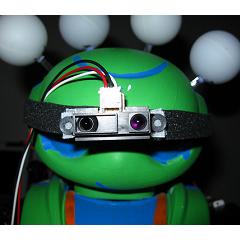
“I mentioned last week that I wanted to have MANOI’s RGB LEDs fade in and out at different rates from different starting points to different ending points. Luckily, it was a pretty easy task to accomplish, so now I can share the code with everyone!”

Yaw Rate Gyroscope Interface to PIC
Posted April 25, 2012 by Chris
“In this post we will study the ADC ( Analog-to-Digital ) Module of the Microcontroller PIC16F917 . We will study a real circuit of PIC16F917 interfacing to a semiconductor Gyroscope.”

Speed Controller + RPM Counter
Posted April 18, 2012 by Chris
“In this tutorial we will take advantage of PIC18F14K50 pulse steering mode to drive the DC Motor and at the same time we will build the RPM (Rotation per Minute) counter to observe the PWM effect on the DC Motor speed and display it on the 2×16 LCD.”

10-Finger Flex Sensor Gloves
Posted April 16, 2012 by Chris
“I built a pair of flex sensor gloves for capturing the motion of all ten fingers. This system uses individual flex sensors made by Spectra Symbol and a National Instruments analog capture device to record the flex sensors’ values.”

Levitating Digital Scale
Posted March 13, 2012 by Chris
“The battery-powered Levitating Digital Scale electromagnetically levitates a load platform, and uses a linear hall-effect sensor to measure the magnetic field strength to determine the weight of the platform. The levitating platform is embedded with a permanent magnet that opposes the magnetic field of a solenoid (the electromagnet). When a load is placed on the platform, the levitating platform will settle to a new height.”

Self-Balancing Electric Unicycle
Posted March 9, 2012 by Chris
“To estimate its orientation, Bullet integrates readings from the gyro and accelerometer using a complementary filter. To balance, the angle estimate is fed through a PID loop (with no integral term). The loop runs at 625 Hz. The output from this stage determines the duty cycle of a 1.22 kHz PWM signal, which is connected to the H-bridge. The code was written in C, and is in the public domain.”

justDIY: LEDs As Sensors
Posted February 25, 2012 by Chris
“Each slave normally runs in a infinite loop, sampling the LED sensors as fast as it can and storing their values in a memory buffer. When a polling request is received from the master, an interrupt is generated which branches out of the sampling loop. I2C commands are pretty complex on paper, but merely a matter of setting and clearing bits in the digital world, so at 20mHz the pic handles them with lightning speed.”
BXFlyer Four Rotor Helicopter
Posted February 21, 2012 by Chris
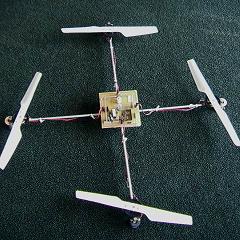
“I decided to build an autonomous flying robot about three years ago. I’ve converted RC cars to autonomous operation, so I thought that an RC helicopter might be a good place to start. I quickly discovered that the standard helicopter design would probably be too unstable in flight for my simple navigational and programming skills – but in searching the web I stumbled across the four rotor electric helicopter platform…and I was hooked!”
Digital Lock With Clock And Temp Sensor
Posted February 3, 2012 by Chris
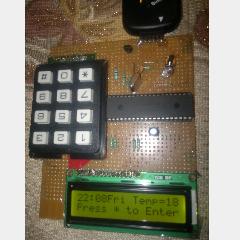
“This Digital code lock can be used for security purposes on doors, cupboards, desks, etc. Once installed it works without any maintenance and there is no need to keep a key. It also shows the time, day and current room temperature on its home screen which is sensed using a LM35 temperature sensor.”
Currently Hot

An Arduino Outputting VGA Signals
output some basic vga using an arduino uno

Super Simple Arduino Tachometer
build an arduino tachometer and measure rpms

Arduino 16×2 LCD Interface
display characters on an lcd using your arduino

DE0-Nano FPGA Tilt Sensing
use the de0-nano board to sense tilt and acceleration
DE0-Nano FPGA Breakout Board
build your own custom i/o expander breakout board
Animatronics

Recent Articles

Arduino DDS Shield
build your own arduino based analog signal generator

A Digital Multimeter In Review (Tenma 72-7735)
learn about your typical digital multimeter in review

The PIC Annoy PCB
build something to annoy your co-workers

Automate Your Life With Cron
learn how to use cron for computer automation

Web Scraping For Weather Updates
learn how to use php to scrape the web

Creating A Web Server In Linux
learn how to make a lamp web server in linux

Stepper Motor Control With A stepRocker TMCM-1110
learn how a commercial stepper motor controller works

Arduino To PIC Wireless Proximity Motor Control
control a motor with a distance sensor wirelessly

PIC to Arduino Wireless Communication via XBee
use xbee to make a pic wirelessly talk to an arduino

Motor Control via Infrared Distance Sensor
control a motor simply by waving your hand

