



Get started learning to build your own electronics by following our FREE online courses below!
Learn More »
Categories
- animatronics (12)
- apple (11)
- arduino (179)
- art (41)
- articles (121)
- artificial intelligence (11)
- automation (421)
- avr (205)
- bitcoin (3)
- breadboard (9)
- cameras (57)
- cars (26)
- cell phones (28)
- clothing mods (21)
- console mods (26)
- dangerous (94)
- desktop mods (24)
- embedded (5)
- flying things (54)
- fpga (22)
- gaming creations (108)
- interface (225)
- internet (17)
- laptop mods (6)
- lasers (22)
- linux (7)
- magnetic (3)
- medical (12)
- microcontrollers (51)
- misc projects (152)
- msp (12)
- music (124)
- pic (90)
- projects (23)
- pyroedu (76)
- raspberry pi (26)
- robots (312)
- security (36)
- sensors (307)
- software (200)
- solar (19)
- stamp (9)
- tools (149)
- tutorials (98)
- Uncategorized (45)
- usb (44)
- wireless (256)
Sponsors
Build Like A Pyro!
Find many of the parts used on this site at our favorite online electronics shop


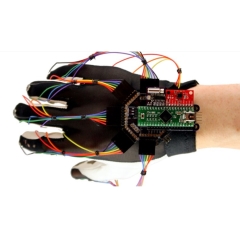
Keyglove Tech In
Posted April 24, 2016 by Chris
"The Keyglove is an innovative new way to interact with your technology. A wearable, wireless, open-source input device, the Keyglove provides unprecedented flexibility and convenience for gaming, design, art, music, data entry, device control, 3D object manipulation, and even inexpensive telepresence."
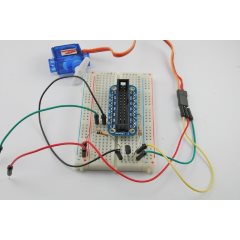
Raspberry Pi GPIO driving Servo
Posted March 9, 2016 by Chris
"I have experimented with GPIO on the Raspberry Pi, just turning an LED on and off here. But since then Ben Croston has improved the RPi GPIO Python library to do most of the work in C and I can confirm that it is a lot faster. Driving servo motors requires precise timing, so I decided to see how the Pi would perform this task."

Dual Motor L298 H-Bridge Motor Control
Posted February 9, 2016 by Chris
"Dual Motor L298 H-Bridge Control project can control two DC motors connected to it. The circuit has been designed around popular dual H-Bridge L298 from ST. This circuit has current sense resistors for both H-bridges to provide voltage which enables this board to use in stepper motor applications."

Chip-8 Emulator
Posted February 5, 2016 by Chris
"I’m taking a microprocessor applications class this semester and the final project was to spend the last three weeks making whatever I wanted. I ended up making a Chip-8 emulator for the PIC32MX270F256B microcontroller. Here’s the final circuit."
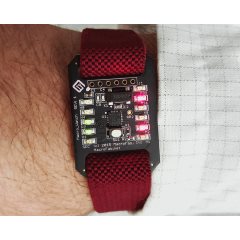
Designing and Building the Macro Watch
Posted February 3, 2016 by Chris
"Three weeks before the Houston Maker Faire Chris came to me asking if we could whip up a low cost giveaway for the faire. I wanted to giveaway something more than a blinky LED badge since that is the typical electronic swag at Maker Faire. It had to be something that the person would wear and would want to show off to other Makers to spread the word about MacroFab. Blinking LEDs are always necessary though."

Motor Controlled via Eye Tracker
Posted February 1, 2016 by Chris
"This section explains the details of the hardware and software used to create the eye-tracker controlled robot arm. Hardware: USB LEGO Cam, Simulated Eye, and LEGO Mindstorms NXT Robot Hand"

Mini-PCIe microcontroller and make your board too
Posted January 21, 2016 by Chris
"I have just recently finished this board, and been able to test it briefly with Springboard and also with the VAB-820. The picture just below shows the shining blue LED, that is tied to D13 – the 13th digital pin, as most Arduinos do."
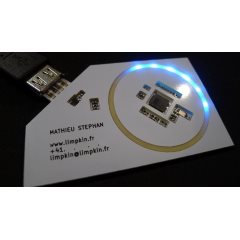
My Business Card v2 (PCB Card)
Posted January 11, 2016 by Chris
"At the end of this month, I’ll be leaving my current job. I therefore thought it’d be a nice occasion to build a new business card for my future interviews. You may remember the first version of my business card made more than one and a half years ago (time flies!). It was basically made of two PCBs soldered together."
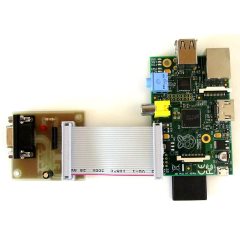
Raspberry PI Serial Port and Breakout Board
Posted November 5, 2015 by Chris
"A simple single-sided board that connects a RS-232 serial port to the Raspberry PI and breaks out some of the PI’s pins for experimentation. The interface board was designed to be simple and used for initial experimentation. It can be built on a single-sided PCB using home-made PCB fabrication methods."
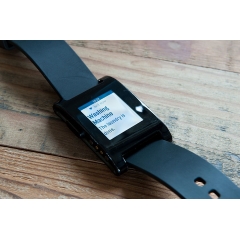
Receiving SMS Notifications From Your Washer & Dryer
Posted September 16, 2015 by Chris
"In this post, I’m going to cover a new project I recently finished – creating a device that monitors a washer or dryer and sends a text message when it detects that a load of laundry has finished. Beyond the novelty and simplicity of receiving a text message when the laundry is done, I built this device for two reasons."
Currently Hot

PIC Prototyping Basics
build your own pic prototype development board

Servo Motor Control
control a hi-tec hs-422 servo motor with a pic

The Wooden Menace
a mighty robotic arm powered by servos

DC Motor Control
control a dc motor with a pic microcontroller

Programming The PIC
learn how to program a pic with the tiny icd2
Animatronics

Recent Articles

Arduino DDS Shield
build your own arduino based analog signal generator

A Digital Multimeter In Review (Tenma 72-7735)
learn about your typical digital multimeter in review

The PIC Annoy PCB
build something to annoy your co-workers

Automate Your Life With Cron
learn how to use cron for computer automation

Web Scraping For Weather Updates
learn how to use php to scrape the web

Creating A Web Server In Linux
learn how to make a lamp web server in linux

Stepper Motor Control With A stepRocker TMCM-1110
learn how a commercial stepper motor controller works

Arduino To PIC Wireless Proximity Motor Control
control a motor with a distance sensor wirelessly

PIC to Arduino Wireless Communication via XBee
use xbee to make a pic wirelessly talk to an arduino

Motor Control via Infrared Distance Sensor
control a motor simply by waving your hand

