



Get started learning to build your own electronics by following our FREE online courses below!
Learn More »
Categories
- animatronics (12)
- apple (11)
- arduino (179)
- art (41)
- articles (121)
- artificial intelligence (11)
- automation (421)
- avr (205)
- bitcoin (3)
- breadboard (9)
- cameras (57)
- cars (26)
- cell phones (28)
- clothing mods (21)
- console mods (26)
- dangerous (94)
- desktop mods (24)
- embedded (5)
- flying things (54)
- fpga (22)
- gaming creations (108)
- interface (225)
- internet (17)
- laptop mods (6)
- lasers (22)
- linux (7)
- magnetic (3)
- medical (12)
- microcontrollers (51)
- misc projects (152)
- msp (12)
- music (124)
- pic (90)
- projects (23)
- pyroedu (76)
- raspberry pi (26)
- robots (312)
- security (36)
- sensors (307)
- software (200)
- solar (19)
- stamp (9)
- tools (149)
- tutorials (98)
- Uncategorized (45)
- usb (44)
- wireless (256)
Sponsors
Build Like A Pyro!
Find many of the parts used on this site at our favorite online electronics shop


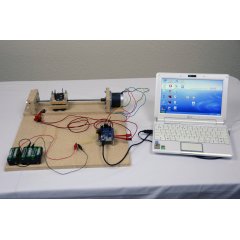
Stepper Motor Control With A stepRocker TMCM-1110
Posted January 24, 2013 by Chris
“In this article we’ll explore how to use a commercial motor controller board to tell a stepper motor what to do. We’ll also explore some additional functionality of the board including how to setup limit switches as interrupts.”

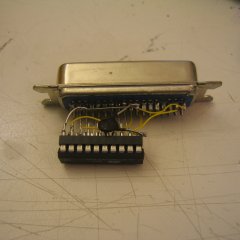
Standalone HPLJ Display Hack
Posted January 23, 2013 by Chris
“A nice thing about the HP laserjets is that they have a little display, and you can use PJL, a sort of controlling language, to change what’s displayed on it, using a bit of code that runs on a PC. Problem was: I didn’t have a PC connected to the laserjet, so I had to divine a standalone solution.”

Quadcopter Control Board
Posted January 21, 2013 by Chris
“I used the standard version of Eagle to create a four-layer board with internal ground and power planes. The board carries an LPC1343 microprocessor which takes input from an onboard sensor stick containing accelerometer, compass, and gyro chips. After some sensor fusion and optionally in response to joystick input, the board provides PWM signals to four brushless DC motor controllers at a rate of 200Hz.”

DIY Home Automation Using Twilio, PowerSwitch, Arduino, and Pusher
Posted January 19, 2013 by Chris
“You may have seen my recent blog post about building a Phone-controlled Robot using Twilio. Since then, I’ve had ideas for new Twilio + Arduino mashups pouring in from the community. Today is the second post in our new series of Twilio Hardware mashups – build your own home automation solution using Twilio SMS, PowerSwitch, Arduino, and PusherApp.”
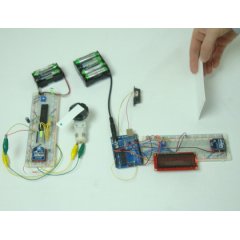
Arduino To PIC Wireless Proximity Motor Control
Posted January 17, 2013 by Chris
“In this article, we will show you how to build a system where the input and output have seperate microcontrollers and are linked together using XBee modules. The input system will use an infrared distance sensor to measure how far away an object is from the sensor and the output will drive a standard DC motor using a power transistor.”
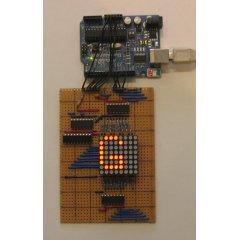
LED Matrix Display With Arduino
Posted December 28, 2012 by Chris
“Last Sunday I gave a workshop in TOG as part of its Engineer’s Week 2011 activities. We spent the day assembling an 8×8 Red/Green LED Matrix Display circuit which I designed in strip board. The circuit forms an interface between a micro controller and an 8 by 8 Dual Color Common Anode LED Module.”

Driving A Stepper Motor Directly From A PIC
Posted December 12, 2012 by Chris
“Much has been written about driving stepper motors. Some sites say it’s easy. Some people say it’s hard. Some people say you have to get the timing and the sequence right, some people say it’s more hassle than it’s worth and you should just buy a stepper driver board! We’ve spent just a few hours today playing about with our stepper motor and found it’s quite straight forward – provided you follow each step slowly and carefully.”
(Very similar to our own Stepper Motor Control article.)

FPGA To PSP LCD Interface With A Spartan 3
Posted December 5, 2012 by Chris
“The following explains the design of a control circuit for the TFT-LCD module LQ043T3DX02 Sharp, best known as the display used in the PlayStation Portable (PSP). It has a 480×272 resolution capable of displaying up to 16 million colors through a data bus 24-bit RGB backlight built.”
(Very similar to our own FPGA ~> PSP LCD Interface article.)
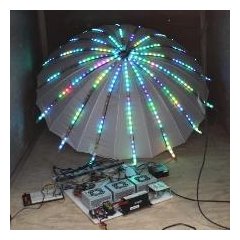
FPGA Control of 10,000 LEDs
Posted November 28, 2012 by Chris
“A major focus of the SoundPuddle project right now is building a new circuit board to run the installation and carry it through the next two years. The installation is controlled by a Papilio FPGA, which connects the other parts of the system – the microphone and audio input hardware, the flash memory, and control hardware for the LED strips. The Zpuino, a softcore running inside the FPGA, handles most of the logic for the system.”
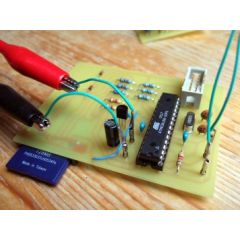
MMC/SD/SDHC AVR Interface
Posted November 9, 2012 by Chris
“This project provides a general purpose library which implements read and write support for MMC, SD and SDHC memory cards. It includes: low-level MMC, SD and SDHC read/write routines, partition table support and a simple FAT16/FAT32 read/write implementation.”
Currently Hot

Automate Your Life With Cron
learn how to use cron for computer automation

Web Scraping For Weather Updates
learn how to use php to scrape the web

Creating A Web Server In Linux
learn how to make a lamp web server in linux

Stepper Motor Control With A stepRocker TMCM-1110
learn how a commercial stepper motor controller works

Arduino To PIC Wireless Proximity Motor Control
control a motor with a distance sensor wirelessly
Animatronics

Recent Articles

Arduino DDS Shield
build your own arduino based analog signal generator

A Digital Multimeter In Review (Tenma 72-7735)
learn about your typical digital multimeter in review

The PIC Annoy PCB
build something to annoy your co-workers
Automate Your Life With Cron
learn how to use cron for computer automation
Web Scraping For Weather Updates
learn how to use php to scrape the web
Creating A Web Server In Linux
learn how to make a lamp web server in linux
Stepper Motor Control With A stepRocker TMCM-1110
learn how a commercial stepper motor controller works
Arduino To PIC Wireless Proximity Motor Control
control a motor with a distance sensor wirelessly

PIC to Arduino Wireless Communication via XBee
use xbee to make a pic wirelessly talk to an arduino

Motor Control via Infrared Distance Sensor
control a motor simply by waving your hand

