



Get started learning to build your own electronics by following our FREE online courses below!
Learn More »
Categories
- animatronics (12)
- apple (11)
- arduino (179)
- art (41)
- articles (121)
- artificial intelligence (11)
- automation (421)
- avr (205)
- bitcoin (3)
- breadboard (9)
- cameras (57)
- cars (26)
- cell phones (28)
- clothing mods (21)
- console mods (26)
- dangerous (94)
- desktop mods (24)
- embedded (5)
- flying things (54)
- fpga (22)
- gaming creations (108)
- interface (225)
- internet (17)
- laptop mods (6)
- lasers (22)
- linux (7)
- magnetic (3)
- medical (12)
- microcontrollers (51)
- misc projects (152)
- msp (12)
- music (124)
- pic (90)
- projects (23)
- pyroedu (76)
- raspberry pi (26)
- robots (312)
- security (36)
- sensors (307)
- software (200)
- solar (19)
- stamp (9)
- tools (149)
- tutorials (98)
- Uncategorized (45)
- usb (44)
- wireless (256)
Sponsors
Build Like A Pyro!
Find many of the parts used on this site at our favorite online electronics shop


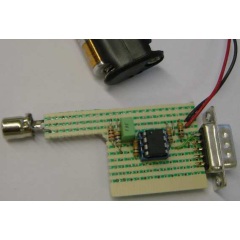
PIC12F675 8-Pin Pong
Posted June 3, 2014 by Chris
"This project is based on ideas from Rickard’s electronic projects page and David B. Thomas VCR Pong. However, I have developed the simplicity even further, eliminating most of the external components. Using microcontrollers with internal 4MHz clock generator there is no need for the xtal. The 12f675 part also operates on wide voltage range, and the regulator can be removed."
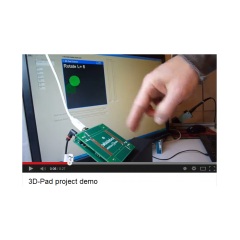
3D Pad – Control Without Touching
Posted April 22, 2014 by Chris
"Arduino shield for controlling something without touching the controller. Great for Touchless Gesture User Interface experiments, artistic expression and game controllers. Does not use special parts, just a bunch of CMOS chips connected to an ATmega328 in the form of an Arduino Uno board."
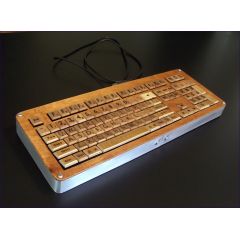
The Scrabble Keyboard
Posted April 19, 2014 by Chris
"This keyboard was commissioned by a couple of friends of mine from back east (NJ) who are avid Scrabble players. Most of the keys are made from real Scrabble tiles that were all hand-beveled (truly an exercise in patience/masochism!) and built onto a USB, clicky, mechanical-switch keyboard."
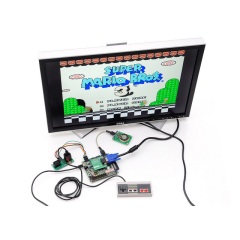
FPGA NES Using Xilinx Spartan3
Posted March 23, 2014 by Chris
"Behold: a complete Nintendo Entertainment System cloned in an FPGA! Originally written in VHDL by Brent Allen and myself while at Washington State University, I’ve recently revisited this project and begun both: rewriting it in Verilog, and adding many new features."
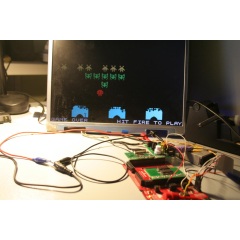
Zx Spectrum on FPGA with 17-inch LCD screen
Posted March 5, 2014 by Chris
"Last time I went through junk in the basement I found old ZX spectrum.This was the time I got the great idea. Have the ZX spectrum implemented in FPGA…..As for the hardware part I had this SparkFun’s Spartan 3 breakout board. 500k gate FPGA that should be big enough most home made projects."
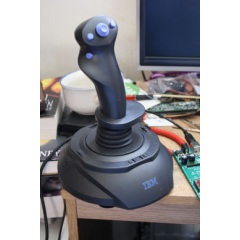
PIC Joystick USB Interface
Posted February 9, 2014 by Chris
"With the phasing out of game, serial and parallel ports from modern computers and the ever increasing popularity of USB, it makes sense that hobbyists start getting to grips working with USB….This project focuses on the use of a USB PIC and the mikroC compiler to convert an old game port joystick to utilize USB."
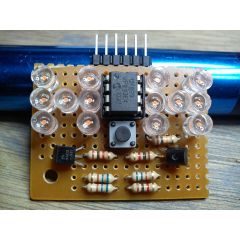
Prototyping A Dual Die Emulator
Posted December 25, 2013 by Chris
"Since I had 100 Pink LEDs, I decided to build something LED intensive. So, using a PIC12F629 as the microcontroller, I decided to build a Dual Die Emulator. Each die would consume 7 LEDs, so I would use 14 LEDs total for the project."
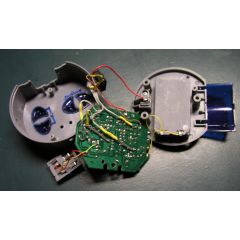
Computer Controlled RC Car
Posted December 12, 2013 by Chris
"I thought up the idea that it would be really cool to control a remote control car controlled by the parallel port. I did some research and Mike Beauchamp did just that and to top it off it’s controllable over the internet."
DIY Tengu on a Breadboard
Posted December 9, 2013 by Chris
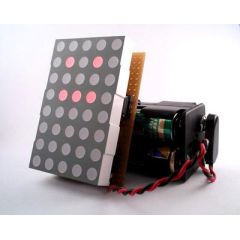
"When I first saw Crispin Jones Tengu, I was sure, I must have one. If you don’t know tengu and don’t want to follow the link, it’s a small face, made of LEDs, that reacts to music and sound.
It did not take long until I decided to clone this funny little device. All it needs is a microcontroller, an LED matrix and a sound sensor."
Human Movement Interface for Fighting Games
Posted December 8, 2013 by Chris
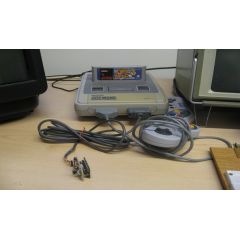
"The original idea was to create a new human interface for a commercial fighting game using two given technologies: Orients and Prospeckz. Orients are a set of sensors which output over the radio their coordinates in a 3 dimensional space plus other physical measurements such as acceleration. The sensors are attached to different parts of a human body, the output data is processed in real time, and models a human body and its movements."
Currently Hot

PIC Prototyping Basics
build your own pic prototype development board

Servo Motor Control
control a hi-tec hs-422 servo motor with a pic

The Wooden Menace
a mighty robotic arm powered by servos

DC Motor Control
control a dc motor with a pic microcontroller

Programming The PIC
learn how to program a pic with the tiny icd2
Animatronics

Recent Articles

Arduino DDS Shield
build your own arduino based analog signal generator

A Digital Multimeter In Review (Tenma 72-7735)
learn about your typical digital multimeter in review

The PIC Annoy PCB
build something to annoy your co-workers

Automate Your Life With Cron
learn how to use cron for computer automation

Web Scraping For Weather Updates
learn how to use php to scrape the web

Creating A Web Server In Linux
learn how to make a lamp web server in linux

Stepper Motor Control With A stepRocker TMCM-1110
learn how a commercial stepper motor controller works

Arduino To PIC Wireless Proximity Motor Control
control a motor with a distance sensor wirelessly

PIC to Arduino Wireless Communication via XBee
use xbee to make a pic wirelessly talk to an arduino

Motor Control via Infrared Distance Sensor
control a motor simply by waving your hand

