



Get started learning to build your own electronics by following our FREE online courses below!
Learn More »
Categories
- animatronics (12)
- apple (11)
- arduino (179)
- art (41)
- articles (121)
- artificial intelligence (11)
- automation (421)
- avr (205)
- bitcoin (3)
- breadboard (9)
- cameras (57)
- cars (26)
- cell phones (28)
- clothing mods (21)
- console mods (26)
- dangerous (94)
- desktop mods (24)
- embedded (5)
- flying things (54)
- fpga (22)
- gaming creations (108)
- interface (225)
- internet (17)
- laptop mods (6)
- lasers (22)
- linux (7)
- magnetic (3)
- medical (12)
- microcontrollers (51)
- misc projects (152)
- msp (12)
- music (124)
- pic (90)
- projects (23)
- pyroedu (76)
- raspberry pi (26)
- robots (312)
- security (36)
- sensors (307)
- software (200)
- solar (19)
- stamp (9)
- tools (149)
- tutorials (98)
- Uncategorized (45)
- usb (44)
- wireless (256)
Sponsors
Build Like A Pyro!
Find many of the parts used on this site at our favorite online electronics shop


Longboard Wheel Display (POV)
Posted November 20, 2012 by Chris
“So I’ve done persistence of vision displays before; there’s really nothing new there. The challenge this time was to make it small enough to fit on a 72mm longboard wheel, and to make it cheap enough so that I could mass produce it and sell it to folks in the area.”
Cracking PDF Passwords via BeagleBone
Posted November 18, 2012 by Chris
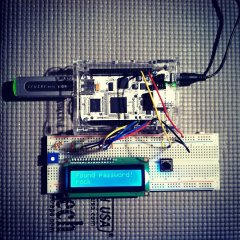
“I am strong proponent of customized embedded systems; a single piece of hardware aimed at solving a single problem. If we have a particular task that is time intensive, repetitive, difficult to configure and somewhat ‘shady’, it is probably best to execute it in hardware. Lets consider a tool for recovering passwords from PDF-files.”

Simple FPGA Controlled Robot
Posted November 12, 2012 by Chris
“This page outlines the complete design for Field Programmable Gate Array (FPGA) controlled robot that exhibits light following, sound sensing, and object detecting abilities. The robot uses an Actel 1020B FPGA to control all of its logic behaviour while external analog circuitry provides the sensory inputs to the FPGA. The purpose of this design is to demonstrate how an FPGA can be effectively used to control a robot.”

Theobald – The Self-Balancing Robot
Posted November 5, 2012 by Chris
“The idea of this project was to design and construct a robot that consists of a body and two wheels that would be able to balance on its own. This behavior is similar how a segway (a new mode of transportation) works. Our goal was to have a working finished product – a robot that, without human interaction, could balance on two wheels.”

Using FPGA’s To Count Coil Windings
Posted October 31, 2012 by Chris
“In the days of yore amateurs used to hack a calculator to simulate a keypress to help them count the coil windings. Calculators are relatively rare and harder to tweak these days. There’s an assortment of other awesome tools around however. For example, a Cyclone II development kit.”


Morse Code Interpreter
Posted October 24, 2012 by Chris
“The project is about design and implement a device that can hear a Morse code through a microphone and translate the to text. the text will be displayed on a 2×16 LCD screen, so the device can only translate 32 character [aA-zZ 0-9] at a time .We use an op-amp to amplify the sound signal, couple of capacitor to filter out the some nasty frequencies and an ATMega8 as processing unit.”
Electronic Design and Prototyping: Botanicalls Clone
Posted October 22, 2012 by Chris
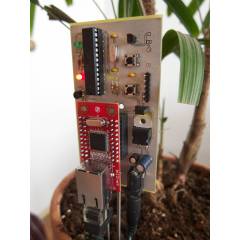
“I decided to design and fabricate a Botanicalls clone because I also wanted to measure ambient light, temperature, and humidity in addition to soil moisture levels. It also gave me a solid reference point from which to explore a software (EagleCAD) and process I had no prior experience with.”

The Tacit Project: Sonar For The Blind
Posted October 19, 2012 by Chris
“It’s wrist mounted and senses objects from about 1 inch (2 cm) to 10 feet (3.5m). It has generally fast response time (fractions of a second) to quickly navigate complex environments. It’s designed to help a vision impaired person to navigate complex environments.”

Eagle in a Rack: Real Time Object Tracking
Posted October 15, 2012 by Chris
“The purpose of this project is to develop a more efficient method for performing real-time object tracking….The project has two main components: the support hardware, and the tracking hardware. The support hardware provides the interface to the real world. The on-screen display is used to display the mouse pointer overtop of the video signal for simple point and click object tracking.”
Currently Hot

An Arduino Outputting VGA Signals
output some basic vga using an arduino uno

Super Simple Arduino Tachometer
build an arduino tachometer and measure rpms

Arduino 16×2 LCD Interface
display characters on an lcd using your arduino

DE0-Nano FPGA Tilt Sensing
use the de0-nano board to sense tilt and acceleration
DE0-Nano FPGA Breakout Board
build your own custom i/o expander breakout board
Animatronics

Recent Articles

Arduino DDS Shield
build your own arduino based analog signal generator

A Digital Multimeter In Review (Tenma 72-7735)
learn about your typical digital multimeter in review

The PIC Annoy PCB
build something to annoy your co-workers

Automate Your Life With Cron
learn how to use cron for computer automation

Web Scraping For Weather Updates
learn how to use php to scrape the web

Creating A Web Server In Linux
learn how to make a lamp web server in linux

Stepper Motor Control With A stepRocker TMCM-1110
learn how a commercial stepper motor controller works

Arduino To PIC Wireless Proximity Motor Control
control a motor with a distance sensor wirelessly

PIC to Arduino Wireless Communication via XBee
use xbee to make a pic wirelessly talk to an arduino

Motor Control via Infrared Distance Sensor
control a motor simply by waving your hand

