



Get started learning to build your own electronics by following our FREE online courses below!
Learn More »
Categories
- animatronics (12)
- apple (11)
- arduino (179)
- art (41)
- articles (121)
- artificial intelligence (11)
- automation (421)
- avr (205)
- bitcoin (3)
- breadboard (9)
- cameras (57)
- cars (26)
- cell phones (28)
- clothing mods (21)
- console mods (26)
- dangerous (94)
- desktop mods (24)
- embedded (5)
- flying things (54)
- fpga (22)
- gaming creations (108)
- interface (225)
- internet (17)
- laptop mods (6)
- lasers (22)
- linux (7)
- magnetic (3)
- medical (12)
- microcontrollers (51)
- misc projects (152)
- msp (12)
- music (124)
- pic (90)
- projects (23)
- pyroedu (76)
- raspberry pi (26)
- robots (312)
- security (36)
- sensors (307)
- software (200)
- solar (19)
- stamp (9)
- tools (149)
- tutorials (98)
- Uncategorized (45)
- usb (44)
- wireless (256)
Sponsors
Build Like A Pyro!
Find many of the parts used on this site at our favorite online electronics shop


Meet Mr. Clappidoo
Posted September 18, 2013 by Chris
“Clappidoo sits quietly and will not bother anyone, unless somebody carelessly puts an object in front of him. Clappidoo will then wake-up and, depending on his ‘mood’ of the moment, will either be: Angry, Happy, Confused or Flirty. Clappidoo will go trough all these moods at random, and will go back to sleep if you remove the annoyance in front of him.”

LEDfirefly Project
Posted September 17, 2013 by Chris
“I’ve made plenty of LED Throwies in my day but I only recently discovered Karl Lunt’s low power LED firefly project. I was immediately inspired to make my own LEDfireflies. Unlike LED Throwies which will only last 4 or 5 days per battery, these LEDfireflies utilize ATTiny AVR microcontrollers and the LED as a light sensor (cool!) to get several weeks of flashing on a single battery.”

Nøkken – ROV (Underwater Exploration Vehicle)
Posted September 16, 2013 by Chris
“This project started about 8 months ago in January 2010, when I saw that a surprising number of people were making ROVs at home. Though very few had footage of anything interesting, it certainly proved the concept was viable. I’ve always been fascinated and fearful of the ocean, so this seemed a great way to explore the depths without having to personally go where the sun doesn’t shine.”

A DIY Clap Sensor
Posted September 15, 2013 by Chris
“The clap sensor is a simple circuit that incorporates a PC microphone, a microcontroller, and an output.I chose the ATtiny84 microcontroller for this project because I’m familiar with the AVR architecture and I have access to the tools to use it. I bought the ATtiny84 in its SOIC-14 packaging. ”
How To Make Nice Looking DIY Front Panel
Posted September 14, 2013 by Chris
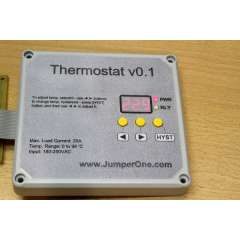
“Want to make really nice looking front panel for your next DIY project? Then you’re in the right place! First you’re gonna need to have some basic tools and materials: InkJet or Laser printer, Utility knife or X-Acto knife, Pair of scissors, General Usage Labels, Self-Adhesive Laminating Sheet, Imagination!”
555 Timer Chip Music Player
Posted September 13, 2013 by Chris
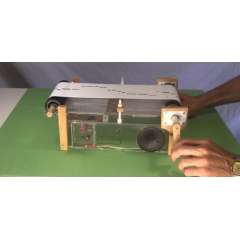
“This is a music player I made for my entry for the 2013 Ottawa Mini-Maker Faire. It’s based on the popular 555 timer chip. My main design criteria was that it had to be far more robust than my previous music player that used pencil marks for the resistors. Those pencil marks wore away from the paper moving over them and taking away the pencil lead.”

Rectifying Diode Circuits – An Introduction To Analog Electronics
Posted September 12, 2013 by Chris
Now it’s time for this week’s Analog Electronics lesson! This time we will explore more about Rectifier diodes. Here’s a quick intro of what this PyroEDU lesson is all about:
In electronics, diodes serve a unique purpose in that they only allow current to flow through them in one direction, which makes them useful for blocking unwanted voltages and guiding current flow. In this lesson, we are going to use that unique property of diodes to rectify a simple AC signal into a flat DC signal.
Wireless Tilt Sensing + Shake-Detection program
Posted September 11, 2013 by Chris
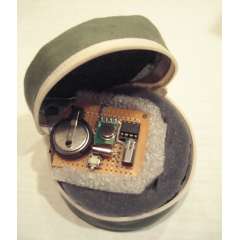
“Goals: [1] Create a wireless device that sends data from a simple tilt switch. [2] Use a PC to capture, analyze, and detect shaking mosion…..Method: Place a simple tilt switch on a wireless RF board (PIC12F675). Receive the RF data onto a USB PIC (PIC18F2550). Transmit the data to a laptop using USB serial port emulation (PBP code). Analyze the data using Processing, identify and visualize shake-motion.”

The TriWheeler Sensor Robot
Posted September 10, 2013 by Chris
“The TriWheeler has a smart autonomous mode that allows the unit to move freely without running into major obstacles. Furthermore, The TriWheeler features 3 speeds and the cruising speed could be easily adjusted using the remote control on the fly.”

SensCap For The Visually Impaired
Posted September 9, 2013 by Chris
“The purpose of this project is to aid the visually impaired with everyday tasks by providing more information to them about their surroundings. Typically, a person with no or poor vision will use a cane while walking to determine the general topography of the area.”
Currently Hot

DIY Stepper Motor Controller
reliable stepper motor control in a diy pcb

The Sharpie Dotifier
a robotic arm that draws everything

Line Following Mini Tank
a wooden tank that follows black lines

Homemade PCB (Etching)
build a pcb board with your bare hands

Simple Motor Optical Encoder
build a simple-low cost optical encoder
Animatronics

Recent Articles

Arduino DDS Shield
build your own arduino based analog signal generator

A Digital Multimeter In Review (Tenma 72-7735)
learn about your typical digital multimeter in review

The PIC Annoy PCB
build something to annoy your co-workers

Automate Your Life With Cron
learn how to use cron for computer automation

Web Scraping For Weather Updates
learn how to use php to scrape the web

Creating A Web Server In Linux
learn how to make a lamp web server in linux

Stepper Motor Control With A stepRocker TMCM-1110
learn how a commercial stepper motor controller works

Arduino To PIC Wireless Proximity Motor Control
control a motor with a distance sensor wirelessly

PIC to Arduino Wireless Communication via XBee
use xbee to make a pic wirelessly talk to an arduino

Motor Control via Infrared Distance Sensor
control a motor simply by waving your hand

