



Get started learning to build your own electronics by following our FREE online courses below!
Learn More »
Categories
- animatronics (12)
- apple (11)
- arduino (179)
- art (41)
- articles (121)
- artificial intelligence (11)
- automation (421)
- avr (205)
- bitcoin (3)
- breadboard (9)
- cameras (57)
- cars (26)
- cell phones (28)
- clothing mods (21)
- console mods (26)
- dangerous (94)
- desktop mods (24)
- embedded (5)
- flying things (54)
- fpga (22)
- gaming creations (108)
- interface (225)
- internet (17)
- laptop mods (6)
- lasers (22)
- linux (7)
- magnetic (3)
- medical (12)
- microcontrollers (51)
- misc projects (152)
- msp (12)
- music (124)
- pic (90)
- projects (23)
- pyroedu (76)
- raspberry pi (26)
- robots (312)
- security (36)
- sensors (307)
- software (200)
- solar (19)
- stamp (9)
- tools (149)
- tutorials (98)
- Uncategorized (45)
- usb (44)
- wireless (256)
Sponsors
Build Like A Pyro!
Find many of the parts used on this site at our favorite online electronics shop


Double Down: An automated card-dealer
Posted August 10, 2013 by Chris
“The Double Down card dealer is a fully programmable automated card dealer. It has the ability to deal a card in two directions (left or right, dealer or player, etc) while at the same time moving linearly perpendicular to those directions (card stack 1, 2, 3, etc).”

ISP for AVR Microcontrollers
Posted August 9, 2013 by Chris
“The FabISP is an in-system programmer for AVR microcontrollers, designed for production within a FabLab. That is, it allows you to program the microcontrollers on other boards you make, using nothing but a USB cable and 6-pin IDC to 6-pin IDC cable. It’s based on the USBtiny and V-USB firmwares, which allow the ATtiny44 to perform USB communication in software.”

Wireless Temperature Sensor using RF Transmitter/Receiver
Posted August 8, 2013 by Chris
“A while back, I did a wireless temperature sensor project using XBee radios….So I decided to try the same project using inexpensive RF devices. I used a 434MHz transmitter ($4) and receiver ($5) from Sparkfun, and had great success with these cheap devices. I also used a simple LM34 Fahrenheit temperature sensor, two Arduinos, and a two-digit LED display to show the temperature at the receiver end.”
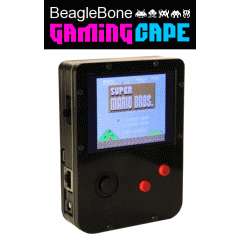
BeagleBone GamingCape
Posted August 7, 2013 by Chris
“The BeagleBone GamingCape transforms your BeagleBone into a full fledged hand-held gaming console capable of playing all the classics such as NES, Gameboy, Sega GameGear, and even Doom. Just drop in 4 AAA batteries and you’ll be playing your favourite games in no time. ”
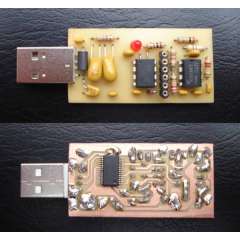
True Random Numbers @ USB
Posted August 6, 2013 by Chris
“This ain’t yet another ultimate, ultrafast and all-too-miniaturized USB-gadget. It is the ‘official’ USB-version of the XR232-TRNG, taking advantage from the benefits of USB, but retaining fundamental XR232-philosophy of independency, security, transparency and compatibility.”
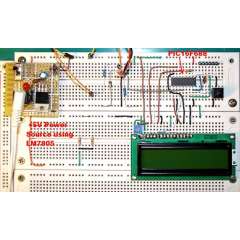
PIC-based Digital Voltmeter (DVM)
Posted August 4, 2013 by Chris
“This project will describe how to make a simple digital voltmeter (DVM) using a PIC16F688 microcontroller. The range of this DVM is 0-20V, but you can easily increase or decrease the range of input voltage as your requirements after you understand the voltage scaling method described in this project.”

Hobby Built Car-like Robot
Posted August 3, 2013 by Chris
“This time we are going to build a remotely controlled car robot, with the next list of features:
- -3 wheels – 2 in the front and 1 one rear.
- -On board camera
- -To mimic real cars, the car robot will have some lights
- -It will carry some sensors on board, which may be used for fun
- -To make it wireless, it will have a Wi-Fi module.”

Designing Lego Mindstorms NXT sensors
Posted August 2, 2013 by Chris
“I bought a Lego Mindstorms kit last month to mess with, I’ve got some ideas for robot localisation that I want to try out. Anyway, the kit comes with a sonar range finder but I wanted a little more accuracy and smaller detection area….A couple of companies sell after market sensors for the NXT, Mindsensors and HiTechnic but it’s much more fun to design and build your own.”

WiFi Enabled Power Monitor
Posted August 1, 2013 by Chris
“I’ve got a pre-paid electricity meter installed at my new place in Cape Town. It outputs a 1/1kWh pulse via a LED on the front panel. I thought it would be pretty cool to read and log the power consumption of my house. It’s also an excuse to play with WiFi and other fun stuff.”
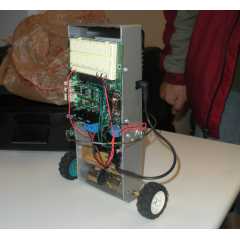
EGGN 482 Final Projects
Posted July 31, 2013 by Chris
“EGGN 482: Microprocessor and microcontroller architecture focusing on hardware structures and elementary machine and assembly language programming skills essential for use of microprocessors in data acquisition, control, and instrumentation systems. Analog and digital signal conditioning, communication, and processing. A/D and D/A converters for microprocessors. RS232 and other communication standards.”
Currently Hot

VHDL Keyboard Input
use vhdl to interface a cpld to a keyboard

Advanced VGA On A UP2
make even cooler stuff appear on your monitor

The Accelerometer
take input from an accelerometer and show some ouput

L298 Stepper Motor Control
control a stepper motor with the l298 (l298hn)

Creating VGA With VHDL
create vga signals with vhdl and the up2 board
Animatronics

Recent Articles

Arduino DDS Shield
build your own arduino based analog signal generator

A Digital Multimeter In Review (Tenma 72-7735)
learn about your typical digital multimeter in review

The PIC Annoy PCB
build something to annoy your co-workers

Automate Your Life With Cron
learn how to use cron for computer automation

Web Scraping For Weather Updates
learn how to use php to scrape the web

Creating A Web Server In Linux
learn how to make a lamp web server in linux

Stepper Motor Control With A stepRocker TMCM-1110
learn how a commercial stepper motor controller works

Arduino To PIC Wireless Proximity Motor Control
control a motor with a distance sensor wirelessly

PIC to Arduino Wireless Communication via XBee
use xbee to make a pic wirelessly talk to an arduino

Motor Control via Infrared Distance Sensor
control a motor simply by waving your hand

