



Get started learning to build your own electronics by following our FREE online courses below!
Learn More »
Categories
- animatronics (12)
- apple (11)
- arduino (179)
- art (41)
- articles (121)
- artificial intelligence (11)
- automation (421)
- avr (205)
- bitcoin (3)
- breadboard (9)
- cameras (57)
- cars (26)
- cell phones (28)
- clothing mods (21)
- console mods (26)
- dangerous (94)
- desktop mods (24)
- embedded (5)
- flying things (54)
- fpga (22)
- gaming creations (108)
- interface (225)
- internet (17)
- laptop mods (6)
- lasers (22)
- linux (7)
- magnetic (3)
- medical (12)
- microcontrollers (51)
- misc projects (152)
- msp (12)
- music (124)
- pic (90)
- projects (23)
- pyroedu (76)
- raspberry pi (26)
- robots (312)
- security (36)
- sensors (307)
- software (200)
- solar (19)
- stamp (9)
- tools (149)
- tutorials (98)
- Uncategorized (45)
- usb (44)
- wireless (256)
Sponsors
Build Like A Pyro!
Find many of the parts used on this site at our favorite online electronics shop


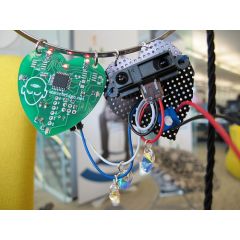
You Make My Heart Flutter – Wearable Sensing Device
Posted January 15, 2014 by Chris
"For the past few weeks I’ve been working on the first stage of a project that involves hacking Eric Boyd’s excellent Heart Spark PCB pendant and combining it with a sensor module I’ve made from scratch."

Programming an ATtiny85
Posted January 12, 2014 by Chris
"I recently decided that I wanted to use an ATtiny85 for a small project I have in mind. So I ordered a couple from DigiKey. Once I got them I realized that I only had a very vague Idea on how to go about programming them. I ended up following instruction from the brilliant people of the High-Low Tech group at MIT."

Keyboard I/O Hack
Posted January 8, 2014 by Chris
"A keyboard hack that supports input as well as output. You find many example of keyboard hacks on the web – basically you take out the PCB of the keyboard an replace the keys with something more interesting…"
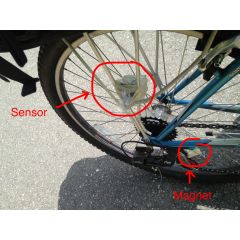
A Bicycle Computer
Posted January 3, 2014 by Chris
"My first Physical Computing class assignment for this summer was to create a bicycle computer. This is a device that you stick on your bike and it tells you how fast you are going, what your speed is, etc. Following is how I made my own bicycle computer. I used an Arduino to power several features. Data from these features were then displayed on an LCD screen."

PS/2 to C64 Mouse Adapter
Posted January 3, 2014 by Chris
"A pixel artist friend of mine wanted a mouse to try his skills on a real C64. I thought I could help him by making an adapter that would allow a regular PS/2 mouse to be used with a Commodore 64. The most popular and supported C64 mouse is 1351 mouse which uses analog capabilities of joystick control ports to send movement data."
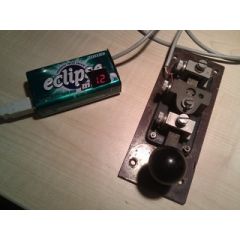
Morse Key USB keyboard
Posted December 11, 2013 by Chris
"That’s what the Morse Keyboard is all about. This little project I built plugs into a computer’s USB port and is seen by the computer as a standaard USB keyboard. As you tap out Morse, the device types each letter to your computer just like a standaard keyboard!"
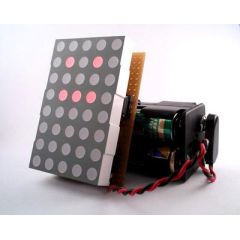
DIY Tengu on a Breadboard
Posted December 9, 2013 by Chris
"When I first saw Crispin Jones Tengu, I was sure, I must have one. If you don’t know tengu and don’t want to follow the link, it’s a small face, made of LEDs, that reacts to music and sound.
It did not take long until I decided to clone this funny little device. All it needs is a microcontroller, an LED matrix and a sound sensor."
Human Movement Interface for Fighting Games
Posted December 8, 2013 by Chris
"The original idea was to create a new human interface for a commercial fighting game using two given technologies: Orients and Prospeckz. Orients are a set of sensors which output over the radio their coordinates in a 3 dimensional space plus other physical measurements such as acceleration. The sensors are attached to different parts of a human body, the output data is processed in real time, and models a human body and its movements."

Motion and Context Sensing for Pen Computing
Posted December 6, 2013 by Chris
"I continue to believe that stylus input — annotations, sketches, mark-up, and gestures — will be an important aspect of interaction with slate computers in the future, particularly when used effectively and convincingly with multi-modal pen+touch input. It also seems that every couple of years I stumble across an interesting new use or set of techniques for motion sensors, and this year proved to be no exception."

RepRap Printed Circuits
Posted November 30, 2013 by Chris
"Here is a stab at the Arduino compatible Sanguino board (albeit simplified). It’s pretty standard except we’ve removed the reset circuitry and alot of the pins. We still have 4 controllable pins, one for the LED and three spare for something fun in future. Once again the plastic was printed before dropping in pre-tinned components and finally printing the metal tracks."
Currently Hot

Automate Your Life With Cron
learn how to use cron for computer automation

Web Scraping For Weather Updates
learn how to use php to scrape the web

Creating A Web Server In Linux
learn how to make a lamp web server in linux

Stepper Motor Control With A stepRocker TMCM-1110
learn how a commercial stepper motor controller works

Arduino To PIC Wireless Proximity Motor Control
control a motor with a distance sensor wirelessly
Animatronics

Recent Articles

Arduino DDS Shield
build your own arduino based analog signal generator

A Digital Multimeter In Review (Tenma 72-7735)
learn about your typical digital multimeter in review

The PIC Annoy PCB
build something to annoy your co-workers
Automate Your Life With Cron
learn how to use cron for computer automation
Web Scraping For Weather Updates
learn how to use php to scrape the web
Creating A Web Server In Linux
learn how to make a lamp web server in linux
Stepper Motor Control With A stepRocker TMCM-1110
learn how a commercial stepper motor controller works
Arduino To PIC Wireless Proximity Motor Control
control a motor with a distance sensor wirelessly

PIC to Arduino Wireless Communication via XBee
use xbee to make a pic wirelessly talk to an arduino

Motor Control via Infrared Distance Sensor
control a motor simply by waving your hand

