



Get started learning to build your own electronics by following our FREE online courses below!
Learn More »
Categories
- animatronics (12)
- apple (11)
- arduino (179)
- art (41)
- articles (121)
- artificial intelligence (11)
- automation (421)
- avr (205)
- bitcoin (3)
- breadboard (9)
- cameras (57)
- cars (26)
- cell phones (28)
- clothing mods (21)
- console mods (26)
- dangerous (94)
- desktop mods (24)
- embedded (5)
- flying things (54)
- fpga (22)
- gaming creations (108)
- interface (225)
- internet (17)
- laptop mods (6)
- lasers (22)
- linux (7)
- magnetic (3)
- medical (12)
- microcontrollers (51)
- misc projects (152)
- msp (12)
- music (124)
- pic (90)
- projects (23)
- pyroedu (76)
- raspberry pi (26)
- robots (312)
- security (36)
- sensors (307)
- software (200)
- solar (19)
- stamp (9)
- tools (149)
- tutorials (98)
- Uncategorized (45)
- usb (44)
- wireless (256)
Sponsors
Build Like A Pyro!
Find many of the parts used on this site at our favorite online electronics shop


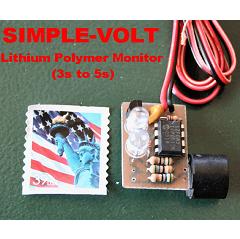
Simple-Volt Battery Monitor
Posted May 14, 2012 by Chris
“This project involved the building of ‘Simple-Volt’, a tiny, light-weight R/C Battery Voltage Monitor using a PIC microcontroller. This PIC project includes an A-to-D application that measures the voltage of a battery pack via a resistor divider network, compares it to a reference voltage (5v regulator) and then displays the battery voltage on 2 LEDs, indicating battery voltage strength.”

An Automatic Chicken Door Opener
Posted April 14, 2012 by Chris
“We recently got chickens and found them to be noisy in the morning because they wanted to be let out of their coop. Of course, we just wanted to sleep in. What we needed was an automatic door opener. There are some (expensive) automatic chicken doors that are available for purchase, but I decided to design and make my own. You are welcome to copy or adapt the design to suit your own requirements.”

Human Tetris: Video Object Tracking
Posted March 20, 2012 by Chris
“For our project, we wanted to push the video sampling and processing capabilities of the ATmega644 8-bit microcontroller. Using a high-speed analog-to-digital converter as an input device, we were able to sample a reasonably high-resolution grayscale image from a color camera’s video output. Using this grayscale image, we are able to track objects and recognize shapes that stood out from the background by a customizable threshold.”

Self-Balancing Electric Unicycle
Posted March 9, 2012 by Chris
“To estimate its orientation, Bullet integrates readings from the gyro and accelerometer using a complementary filter. To balance, the angle estimate is fed through a PID loop (with no integral term). The loop runs at 625 Hz. The output from this stage determines the duty cycle of a 1.22 kHz PWM signal, which is connected to the H-bridge. The code was written in C, and is in the public domain.”

Mini-Z Track TimerX
Posted March 5, 2012 by Chris
“The circuit is based around the Atmel AT90S8515. All but 1 of the I/O pins have been used: 15 for the display multiplexing, 1 for the buzzer, 3 for the input switches, 4 for the track lap sensors, 5 for the gantry lights (4 are dedicated to the ISP programming). There are a total of 32 display digits, each made of 7 segments and 1 decimal place. Hence there are 8×32, or 256 LEDs to control. The multiplexing is done by using 5 I/O pins to select the digit, and 8 I/O pins to select the segments”

Op Amp PID Controller Design
Posted February 2, 2012 by Chris
“We’ve all heard about the wonders of the PID controller, bringing a system’s output – temperature, velocity, light – to its desired set point quickly and accurately. But now, your boss says okay, design one for us. Although there’s a number of ways to do it, the circuit above nicely separates the three terms into three individual op amp circuits. We’ll build it in SPICE, test each term and finally place it inside a motor speed controller for you to tune.”

Custom I2C Servo Motor Controller
Posted January 31, 2012 by Chris
“This is the servo controller for my robot. It uses a MC33887 H-Bridge chip to power the motor, an Atmega88 as the contoller, and an I2C interface. It was designed to be the motion drive for a robot, but being a servo drive with position feedback, I will probably use it to rotate and elevate the turret, and possibly use it for the sonar movement.”

Temperature Data Logger Using PIC
Posted January 29, 2012 by Chris
“This project describes an easy and inexpensive way of adding a digital thermometer and data logging feature to a PC. It involves a PIC microcontroller that gets the surrounding temperature information from the Microchip MCP9701 sensor, and sends it to a PC through an USB-UART interface. The USB port of the PC is also used to power the device.”
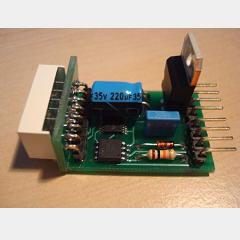
Motorcycle Universal Gear Indicator
Posted January 27, 2012 by Chris
“This is a new design for a universal gear indicator that can be fitted to any motorcycle as an aftermarket accessory. Its main advantage is that its operation depends entirely on the gear shift lever movement, instead of connecting to speedometer and tachometer sensors….It consists of a main circuit including a 7 segment LED indicator, two Hall sensors that are attached to the motorcycle frame, and a small magnet placed on the gear shift lever.”
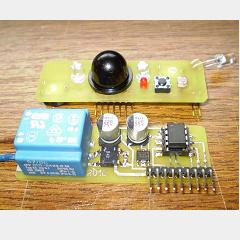
Outdoor Motion Sensing Light Controller
Posted January 22, 2012 by Chris
“Those days when I come home at night and straight into the darkness are finally over. This is a very practical device and I built it so that it is a module to my Dual Channel IR Remote Control. Because of that I ended up with a definite overkill of what is supposed to be a simple switch with a timer when I open/close my door. Anyway, it is modular+wireless and that’s what I like.”
Currently Hot

Arduino LED Flashing Introduction
begin your journey learning about the arduino here

Wireless XBee Motor Control
wireless dual dc motor control via xbee

DIY Mini PIC Development Board
build your own quick, easy and awesome pic dev board

Wireless XBee Pan/Tilt With Servos
build a wireless pan/tilt system for your camera

PIC Prototyping: MPLABX + PICKIT3 Intro
learn how to use mplabx with the new pickit3
Animatronics

Recent Articles

Arduino DDS Shield
build your own arduino based analog signal generator

A Digital Multimeter In Review (Tenma 72-7735)
learn about your typical digital multimeter in review

The PIC Annoy PCB
build something to annoy your co-workers

Automate Your Life With Cron
learn how to use cron for computer automation

Web Scraping For Weather Updates
learn how to use php to scrape the web

Creating A Web Server In Linux
learn how to make a lamp web server in linux

Stepper Motor Control With A stepRocker TMCM-1110
learn how a commercial stepper motor controller works

Arduino To PIC Wireless Proximity Motor Control
control a motor with a distance sensor wirelessly

PIC to Arduino Wireless Communication via XBee
use xbee to make a pic wirelessly talk to an arduino

Motor Control via Infrared Distance Sensor
control a motor simply by waving your hand

