



Get started learning to build your own electronics by following our FREE online courses below!
Learn More »
Categories
- animatronics (12)
- apple (11)
- arduino (179)
- art (41)
- articles (121)
- artificial intelligence (11)
- automation (421)
- avr (205)
- bitcoin (3)
- breadboard (9)
- cameras (57)
- cars (26)
- cell phones (28)
- clothing mods (21)
- console mods (26)
- dangerous (94)
- desktop mods (24)
- embedded (5)
- flying things (54)
- fpga (22)
- gaming creations (108)
- interface (225)
- internet (17)
- laptop mods (6)
- lasers (22)
- linux (7)
- magnetic (3)
- medical (12)
- microcontrollers (51)
- misc projects (152)
- msp (12)
- music (124)
- pic (90)
- projects (23)
- pyroedu (76)
- raspberry pi (26)
- robots (312)
- security (36)
- sensors (307)
- software (200)
- solar (19)
- stamp (9)
- tools (149)
- tutorials (98)
- Uncategorized (45)
- usb (44)
- wireless (256)
Sponsors
Build Like A Pyro!
Find many of the parts used on this site at our favorite online electronics shop


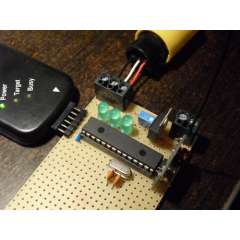
Reading Nintendo 64 controller with PIC microcontroller
Posted September 28, 2013 by Chris
"I have a few old N64 controllers lying around and figured that it would be pretty cool to use them to control other things. In this article I will describe in detail every step I took to achieve this. I’ve used a PIC microcontroller, but it should not be too hard to port the code to any other architecture."
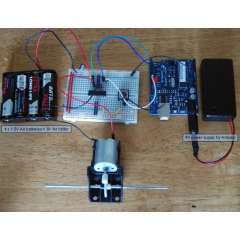
Control a DC motor with Arduino + L293D
Posted September 27, 2013 by Chris
"This is a quick guide with a bit of extra info that I’ve learnt along the way on how to use the L293D with the Arduino, showing that we can: A) Use a supplemental power source to power the DC motor, B) Use the L293D chip to drive the motor, C) Use a switch to change the direction of the motor."

Passive Filters (RL/RC) – An Introduction To Analog Electronics
Posted September 26, 2013 by Chris
It’s that time again! We’re releasing another lesson on PyroEDU for our Analog Electronics course. This week the lesson is about Passive Analog Filters. Here’s a quick intro of what this PyroEDU lesson is all about:
The most basic passive analog filter comes by combining together a resistor and a capacitor or a resistor and an inductor. In this lesson we are going to learn how to build and design some basic RC and RL filters and see the effect of these filters on a simple audio signal.

Hillbilly Tracking of Low Earth Orbit Satellites
Posted September 25, 2013 by Chris
"An adventure of the Southern Appalachian Space Agency, by Travis Goodspeed, as presented at Summercon 2013, inspired by the lectures of Adam Laurie and Jim Geovedi, with kind assistance from Skytee."

Wireless XBee/Arduino Temperature Sensor
Posted September 24, 2013 by Chris
"I decided to explore the more advanced features of XBee radios by building a remote temperature sensor. You can get quite a bit of control over an XBee radio without a microcontroller at all. You can configure the radio to send sensor readings at particular intervals when it detects changes on certain input pins."
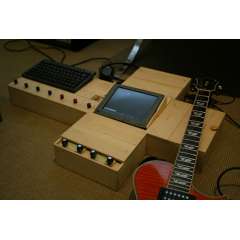
Guitar Pedals Go DIY, Open Source
Posted September 23, 2013 by Chris
The Beavis offers everything you need to wire up 25 sound-shaping circuits, from parts to multi-meter to integrated breadboard. The OpenStomp Coyote takes a different approach, with a programmable processor and Windows visual patching software.
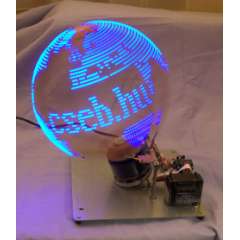
Rotating LED POV Globe
Posted September 22, 2013 by Chris
Here is another twist on the POV clock idea, a POV globe. Although project details are sparse, the creater of this awesome POV glove has put up many detailed photos of his design along with videos of it in action to give you a feel for how it works. A very interesting project!

An Ethernet Weather Station
Posted September 21, 2013 by Chris
“Using an add-on card to the already existing avr ethernet board we build a weather station. That is: A weather station with a build-in webserver…The system is modular. You can either build a pure Ethenet weather station or an Ethenet weather station with an additional local LCD display.”

AVR VGA Generation For A PC Monitor
Posted September 20, 2013 by Chris
“I have always wanted to create a VGA generator. It has been a personal goal of mine for some time. Over the past couple of weeks I toyed with the idea and finally decided to implement one. I decided to implement it as a framebuffer to allow for general purpose display rather than application specific display. I implemented my own small colour gamut to be memory and CPU efficient.”
Zener Diodes – An Introduction To Analog Electronics
Posted September 19, 2013 by Chris
This week at PyroEDU we’re going to be adding another lesson to the Analog Electronics course, called Zener Diodes. Here’s a quick intro of what this PyroEDU lesson is all about:
The zener diode is a special type of diode that allows current to flow through it in either direction, however only at certain voltages. In this lesson we will learn how zener diodes affect AC and DC signals and perform some experiments to see those effects.
Currently Hot

DIY Stepper Motor Controller
reliable stepper motor control in a diy pcb

The Sharpie Dotifier
a robotic arm that draws everything

Line Following Mini Tank
a wooden tank that follows black lines

Homemade PCB (Etching)
build a pcb board with your bare hands

Simple Motor Optical Encoder
build a simple-low cost optical encoder
Animatronics

Recent Articles

Arduino DDS Shield
build your own arduino based analog signal generator

A Digital Multimeter In Review (Tenma 72-7735)
learn about your typical digital multimeter in review

The PIC Annoy PCB
build something to annoy your co-workers

Automate Your Life With Cron
learn how to use cron for computer automation

Web Scraping For Weather Updates
learn how to use php to scrape the web

Creating A Web Server In Linux
learn how to make a lamp web server in linux

Stepper Motor Control With A stepRocker TMCM-1110
learn how a commercial stepper motor controller works

Arduino To PIC Wireless Proximity Motor Control
control a motor with a distance sensor wirelessly

PIC to Arduino Wireless Communication via XBee
use xbee to make a pic wirelessly talk to an arduino

Motor Control via Infrared Distance Sensor
control a motor simply by waving your hand

