



Get started learning to build your own electronics by following our FREE online courses below!
Learn More »
Categories
- animatronics (12)
- apple (11)
- arduino (179)
- art (41)
- articles (121)
- artificial intelligence (11)
- automation (421)
- avr (205)
- bitcoin (3)
- breadboard (9)
- cameras (57)
- cars (26)
- cell phones (28)
- clothing mods (21)
- console mods (26)
- dangerous (94)
- desktop mods (24)
- embedded (5)
- flying things (54)
- fpga (22)
- gaming creations (108)
- interface (225)
- internet (17)
- laptop mods (6)
- lasers (22)
- linux (7)
- magnetic (3)
- medical (12)
- microcontrollers (51)
- misc projects (152)
- msp (12)
- music (124)
- pic (90)
- projects (23)
- pyroedu (76)
- raspberry pi (26)
- robots (312)
- security (36)
- sensors (307)
- software (200)
- solar (19)
- stamp (9)
- tools (149)
- tutorials (98)
- Uncategorized (45)
- usb (44)
- wireless (256)
Sponsors
Build Like A Pyro!
Find many of the parts used on this site at our favorite online electronics shop


TARDIS Pinewood Derby Car
Posted March 9, 2014 by Chris
"This January my daughter decided that she wanted to join in her brother’s cub pack’s Pinewood derby with a replica of Doctor Who’s TARDIS on wheels. Her design was pretty straightforward – balsa wood trim, poster paint, paper cutouts for the windows and sign, and her construction was quickly nearing completion…."

Attiny45 Based USBtinyISP Programmer
Posted March 8, 2014 by Chris
"For a long time, I was looking for a solution to the size of my stk500. Its big, fragile, and requires external power and a large USB to serial cable. It seemed like the solution was one of these, a tiny (haha) programmer based around an attiny45/48. Since I had the parts left over from The Secret Knowledge (more on this later) that would let me implement v-usb, and some attiny45 in my room, I decided to give it a shot. Along the way there were a few roadblocks:"

Playing Musical Notes On A Microcontroller
Posted March 7, 2014 by Chris
"We have discussed in the past experiments how to use a PIC microcontroller to do a variety of things from flashing an LED to driving a motor, etc. Today, we will see how to play notes of a song with a PIC microcontroller. Musical notes are simply sound waves of particular frequencies."


PyroEDU: Introduction to Microcontrollers Kits Available
Posted March 6, 2014 by Syd
We are just one week away from publishing PyroEDU’s fourth course, An Introduction to Microcontrollers and we’re really excited to share it with you. Our friends over at Gadgetory.com are offering parts kits that provide all the materials necessary to complete the course. If you’ve bought a kit for a previous PyroEDU course, all you need is the Components Kit. If this is your first time buying a kit, you will want the Complete Kit.
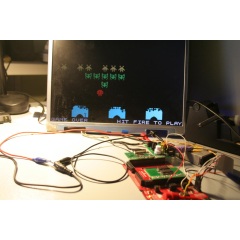
Zx Spectrum on FPGA with 17-inch LCD screen
Posted March 5, 2014 by Chris
"Last time I went through junk in the basement I found old ZX spectrum.This was the time I got the great idea. Have the ZX spectrum implemented in FPGA…..As for the hardware part I had this SparkFun’s Spartan 3 breakout board. 500k gate FPGA that should be big enough most home made projects."

Building an Arduino Robot
Posted March 4, 2014 by Chris
"I have decided to do a small hardware project to get my feet wet, a project that I will fully document and discuss here with the hope to encourage and motivate others to do the same: Building an Arduino Robot."

Physical Tone Matrix
Posted March 3, 2014 by Chris
"Inspired by Andre’ Michelle’s Tone Matrix flash applet I decided to make a physical version – i.e. a box with buttons, flashing lights and knobs to turn. I wanted 16×16 – the Bliptronic 5000 just doesn’t have enough lights."

The Cramp – MSP430 Powered Desktop Crane Lamp
Posted March 2, 2014 by Chris
"The Cramp uses an old HDD as its base, with the crane spinning around the main bearing that previously supported the platter. A system of spools and pulleys provides a reasonable range of motion to the rest of the build. Relocating the entire assembly, however, is evidently an unpleasant task."

FPGA Based UNIX Crypt Hardware Password Cracker
Posted March 1, 2014 by Chris
"The goal is to get a ~100 Euro unit to do 10 million key guesses per second. This device is built for the fun of building it and to see what’s possible with current hardware."

PyroEDU: An Introduction To Microcontrollers (Starts March 13th)
Posted February 27, 2014 by Chris
Thanks to continued support and feedback from all of YOU, we are excited to announce that the 4th course of PyroEDU: An Introduction To Microcontrollers will begin next month! Here’s a preview of the course overview:
“This course is meant to create a pathway into learning about microcontrollers, for people who are scared of the hardware and software trickery that comes with it. A hands-on approach is taken in this course through a combination of lecture and experimentation to teach you about the different functions that microcontrollers have. Additionally, visuals are used throughout lectures like step-by-step schematic building and line-by-line code explanations.”
This course comes right on the heels of An Introduction To Digital Electronics and An Introduction To Analog Electronics and as such, it will use knowledge from both of those courses to further expand to the world of processors, microcontrollers and programmed devices in general. Also, thanks again to all of our kickstarter backers who originally got us started! Read more at the course page at PyroEDU
Currently Hot

DIY FPGA Programmer (For Altera Devices)
build the updated byteblastermv to program altera fpga devices

RGB LED Control via PIC
learn how to display every color on an rgb led

EECE 343 Final FPGA Projects
some example FPGA design using the up2 board

Xbee Wireless Servo Control
control servo motors wirelessly with xbee wifi modules

DE0 Nano Intro Tutorial
learn the basics needed to use the de0 nano
Animatronics

Recent Articles

Arduino DDS Shield
build your own arduino based analog signal generator

A Digital Multimeter In Review (Tenma 72-7735)
learn about your typical digital multimeter in review

The PIC Annoy PCB
build something to annoy your co-workers

Automate Your Life With Cron
learn how to use cron for computer automation

Web Scraping For Weather Updates
learn how to use php to scrape the web

Creating A Web Server In Linux
learn how to make a lamp web server in linux

Stepper Motor Control With A stepRocker TMCM-1110
learn how a commercial stepper motor controller works

Arduino To PIC Wireless Proximity Motor Control
control a motor with a distance sensor wirelessly

PIC to Arduino Wireless Communication via XBee
use xbee to make a pic wirelessly talk to an arduino

Motor Control via Infrared Distance Sensor
control a motor simply by waving your hand

