



Get started learning to build your own electronics by following our FREE online courses below!
Learn More »
Categories
- animatronics (12)
- apple (11)
- arduino (179)
- art (41)
- articles (121)
- artificial intelligence (11)
- automation (421)
- avr (205)
- bitcoin (3)
- breadboard (9)
- cameras (57)
- cars (26)
- cell phones (28)
- clothing mods (21)
- console mods (26)
- dangerous (94)
- desktop mods (24)
- embedded (5)
- flying things (54)
- fpga (22)
- gaming creations (108)
- interface (225)
- internet (17)
- laptop mods (6)
- lasers (22)
- linux (7)
- magnetic (3)
- medical (12)
- microcontrollers (51)
- misc projects (152)
- msp (12)
- music (124)
- pic (90)
- projects (23)
- pyroedu (76)
- raspberry pi (26)
- robots (312)
- security (36)
- sensors (307)
- software (200)
- solar (19)
- stamp (9)
- tools (149)
- tutorials (98)
- Uncategorized (45)
- usb (44)
- wireless (256)
Sponsors
Build Like A Pyro!
Find many of the parts used on this site at our favorite online electronics shop


Motion and Context Sensing for Pen Computing
Posted December 6, 2013 by Chris
"I continue to believe that stylus input — annotations, sketches, mark-up, and gestures — will be an important aspect of interaction with slate computers in the future, particularly when used effectively and convincingly with multi-modal pen+touch input. It also seems that every couple of years I stumble across an interesting new use or set of techniques for motion sensors, and this year proved to be no exception."

Dual Axis Motorized RC Camera Rig for Lumia 928
Posted December 5, 2013 by Chris
"I got a new phone a couple of weeks ago: the Nokia Lumia 928. It has a great camera, so I decided to build a rig for panning and tilting it. The robot features two degrees of freedom that can be manipulated independently, is controlled through Bluetooth via an easy to use remote, and rotates the phone exactly around where the lens is located."
Salt and Vinegar Etching
Posted December 4, 2013 by Chris
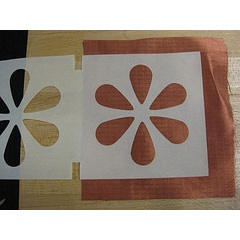
"Use Vaseline as a resist and a bath of salt and vinegar to etch away the copper from copper fabric to make circuits and sensors! Inspired by instructions from Rehmi Post and Kit Waal."
iPhone Controlled Logging Robot
Posted December 3, 2013 by Chris
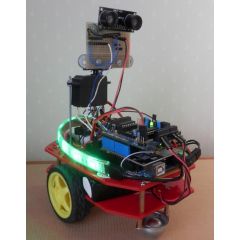
"The challenge here was to integrate different technologies in a working project. In particular I wanted to use the iPhone to send/receive data to/from an Arduino, build a remotely controlled robot using a WiFi network and hook up a data logger station capturing the different sensor data."

Project Longhaul – Adding LEDs To A Ring
Posted December 2, 2013 by Chris
"The final idea was to embed a LED and copper coil assembly inside the titanium ring, illuminating it from under the stones when it was in close proximity to an induced alternating magnetic field. Autodesk Inventor helped me develop all of the dimensions and constraints for the design. Having some help, I was able to obtain her ring size and the rest of the measurements were based from there. "

RepRap Printed Circuits
Posted November 30, 2013 by Chris
"Here is a stab at the Arduino compatible Sanguino board (albeit simplified). It’s pretty standard except we’ve removed the reset circuitry and alot of the pins. We still have 4 controllable pins, one for the LED and three spare for something fun in future. Once again the plastic was printed before dropping in pre-tinned components and finally printing the metal tracks."

TinyPCRemote – An ATtiny85 Infrared PC Remote Control
Posted November 29, 2013 by Chris
"Here’s a cheap way to build your own fully customisable infrared PC remote control. If you already have a suitable infrared remote control going spare you can build one of these for under £4, it will allow you to use most infrared remote controls to issue keyboard commands on your PC."
Tetris on an 16×8 LED Matrix + Theme Music
Posted November 27, 2013 by Chris
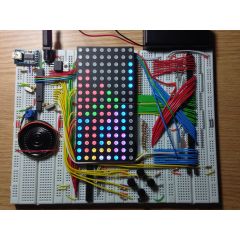
"Since I’ve written a Tetris in Python half a year ago, It wasn’t that difficult for me to write this one for the Arduino. Other than the four arrow keys that are also used for the Snake game, another tact switch was added to immediately drop a piece to the bottom."

Spartan6 FPGA DVI-D Test
Posted November 26, 2013 by Chris
"There is no denying it, Analogue VGA is on the way out. Which is a shame really, because it is so easy to get an FPGA to drive a few resistors and put a picture up on the screen. It’s a great ‘stretch’ project for the FPGA first-timer. But it does have a downside. Each bit of colour resolution required 1 I/O pin and 2 resistors, and then there is an additional couple of sync pins to."

Two-Wheel Balancing Robot Built From Fischertechnik Components
Posted November 25, 2013 by Chris
"During the last months I’ve been working on a 2-wheel balancing robot (also named inverted pendulum). In the meantime you can find a number of similar constructions in the world-wide-web. Most of them are constructions built from self-made parts. Very few use Lego mindstorms parts. I believe that here the first one is described for which fischertechnik components were used. Due to its artistic balancing act I have named this robot ARTIST."
Currently Hot

Build A PSP LCD Interface
learn how to display to a PSP LCD

DIY Stepper Motor Controller
reliable stepper motor control in a diy pcb

The Sharpie Dotifier
a robotic arm that draws everything

Line Following Mini Tank
a wooden tank that follows black lines

Homemade PCB (Etching)
build a pcb board with your bare hands
Animatronics

Recent Articles

Arduino DDS Shield
build your own arduino based analog signal generator

A Digital Multimeter In Review (Tenma 72-7735)
learn about your typical digital multimeter in review

The PIC Annoy PCB
build something to annoy your co-workers

Automate Your Life With Cron
learn how to use cron for computer automation

Web Scraping For Weather Updates
learn how to use php to scrape the web

Creating A Web Server In Linux
learn how to make a lamp web server in linux

Stepper Motor Control With A stepRocker TMCM-1110
learn how a commercial stepper motor controller works

Arduino To PIC Wireless Proximity Motor Control
control a motor with a distance sensor wirelessly

PIC to Arduino Wireless Communication via XBee
use xbee to make a pic wirelessly talk to an arduino

Motor Control via Infrared Distance Sensor
control a motor simply by waving your hand

