



Get started learning to build your own electronics by following our FREE online courses below!
Learn More »
Categories
- animatronics (12)
- apple (11)
- arduino (179)
- art (41)
- articles (121)
- artificial intelligence (11)
- automation (421)
- avr (205)
- bitcoin (3)
- breadboard (9)
- cameras (57)
- cars (26)
- cell phones (28)
- clothing mods (21)
- console mods (26)
- dangerous (94)
- desktop mods (24)
- embedded (5)
- flying things (54)
- fpga (22)
- gaming creations (108)
- interface (225)
- internet (17)
- laptop mods (6)
- lasers (22)
- linux (7)
- magnetic (3)
- medical (12)
- microcontrollers (51)
- misc projects (152)
- msp (12)
- music (124)
- pic (90)
- projects (23)
- pyroedu (76)
- raspberry pi (26)
- robots (312)
- security (36)
- sensors (307)
- software (200)
- solar (19)
- stamp (9)
- tools (149)
- tutorials (98)
- Uncategorized (45)
- usb (44)
- wireless (256)
Sponsors
Build Like A Pyro!
Find many of the parts used on this site at our favorite online electronics shop


Raspberry Pi Moisture Sensor to Monitor Your Plants
Posted March 30, 2014 by Chris
"In this tutorial, I’m going to harness the awesomeness of Raspberry Pi to build a moisture sensor for a plant pot. You will be able to monitor the sensor locally on the LCD or remotely, via ControlMyPi.com, and receive daily emails if the moisture drops below a specified level."

Audio GPS Navigation
Posted March 29, 2014 by Chris
"This project demonstrates the ability to navigate a user based on synthesized directional audio which allows the user to move to a known location without the use of a visual aid. The module uses a GPS, a digital compass, and an ATmega32 to generate sound based on the direction that the user must turn in order to face the correct direction."

Automatic Turn Signal Control
Posted March 28, 2014 by Chris
"This is a circuit to automatically blink the turn signal lights of a car a number of times after a short tap of the turn signal handle. This feature is often found in newer cars these days, but not in my 2000 Volkswagen Passat. Instead of buying a new car, I decided to upgraded it with an Atmel ATtiny12."


Microcontrollers: Input and Output
Posted March 27, 2014 by Chris
Time for some good old fashioned microcontroller Input and Output! The third lesson in our new course: An Introduction To Microcontrollers is now live. Here’s an overview of the lesson:
"All microcontrollers have general purpose input and output pins, often called GPIO. Here we will take a look at how to build a program and hardware to accept push-button input in order to affect output LEDs."

Adding Bluetooth To Your Microcontroller Projects
Posted March 26, 2014 by Chris
"Bluetooth has become Ubiquitous these days Bluetooth Wireless technology is present is Most mobile phones today as well as in laptops and in desktop PCs. And If your PC or laptop doesn’t have it then you can get a Bluetooth USB dongle for cheap! Wouldn’t it be interesting if your mobile phones /PCs could talk to your Microcontroller Projects?"
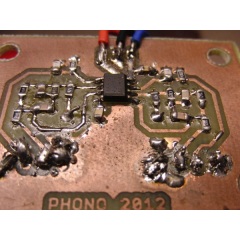
Phono Preamp Electronics Project
Posted March 25, 2014 by Chris
"Mr. Hat contacted me asking for a help in building a phono preamp for his vinyl record player that he recovered from oblivion somewhere. As you probably know, there are some issues with vinyl records that require audio tracks to be mastered in certain way before they are put into a disc."

DIY 8051 Network Cable Tester
Posted March 24, 2014 by Chris
"Designed and built during October 2000, this was my first ever microcontroller based project. This one was inspired by an Edmund Scientific instruments catalog. I didn’t see anything like this in that catalog but there were a lot of nice, year 2000 modern multipole cable testers, that made me think and imagine what would be the simplest possible network cable tester that I could quickly build."
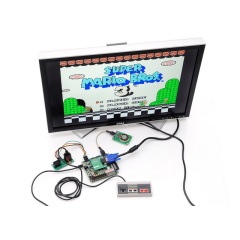
FPGA NES Using Xilinx Spartan3
Posted March 23, 2014 by Chris
"Behold: a complete Nintendo Entertainment System cloned in an FPGA! Originally written in VHDL by Brent Allen and myself while at Washington State University, I’ve recently revisited this project and begun both: rewriting it in Verilog, and adding many new features."

DIY Xilinx Parallel Cable III
Posted March 22, 2014 by Chris
"This is a simple JTAG interface, which can be connected to computer’s parallel port. It is originally designed by Xilinx to program FPGAs and CPLDs… It is a one-sided PCB, the bottom side is made from wires."
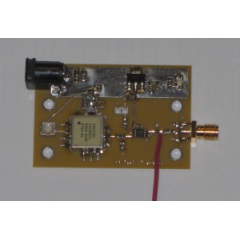
Garage Door Hack
Posted March 21, 2014 by Chris
"One field of communication and DSP that has always intrigued me is signal intelligence, the attempt to receive and decode an unknown signal. It’s an interesting puzzle that requires a wide variety of hardware, software, and analytical skills…I decided I would try to receive and decode the signal my garage door remote transmits to the base unit to open and close the door."
Currently Hot

DIY FPGA Programmer (For Altera Devices)
build the updated byteblastermv to program altera fpga devices

RGB LED Control via PIC
learn how to display every color on an rgb led

EECE 343 Final FPGA Projects
some example FPGA design using the up2 board

Xbee Wireless Servo Control
control servo motors wirelessly with xbee wifi modules

DE0 Nano Intro Tutorial
learn the basics needed to use the de0 nano
Animatronics

Recent Articles

Arduino DDS Shield
build your own arduino based analog signal generator

A Digital Multimeter In Review (Tenma 72-7735)
learn about your typical digital multimeter in review

The PIC Annoy PCB
build something to annoy your co-workers

Automate Your Life With Cron
learn how to use cron for computer automation

Web Scraping For Weather Updates
learn how to use php to scrape the web

Creating A Web Server In Linux
learn how to make a lamp web server in linux

Stepper Motor Control With A stepRocker TMCM-1110
learn how a commercial stepper motor controller works

Arduino To PIC Wireless Proximity Motor Control
control a motor with a distance sensor wirelessly

PIC to Arduino Wireless Communication via XBee
use xbee to make a pic wirelessly talk to an arduino

Motor Control via Infrared Distance Sensor
control a motor simply by waving your hand

